What Does Digital Sovereignty Actually Mean for African Governments?
At Geneva Cyber Week in May 2026, the African Network of Cybersecurity Authorities (ANCA) and RealTyme announced a structured programme to move national cybersecurity authorities across Africa from policy commitments to live sovereign deployment — within 180 days. It is the kind of initiative that sounds straightforward until you ask what "sovereign" actually means in practice. That question is harder than it looks, and the answer matters more than most people realise.
"Digital sovereignty" has become one of the most frequently invoked phrases in African technology policy. Ministers cite it in speeches. Frameworks reference it as a goal. International partnerships promise to advance it. Yet for many government officials charged with actually implementing national cybersecurity strategy, the concept remains frustratingly abstract — a destination without a map.
This matters, because the stakes are no longer theoretical. Africa loses an estimated 10% of its GDP to cyberattacks annually, according to the UN Economic Commission for Africa. In 2026, 62% of African audit leaders ranked cyber incidents as the main business risk facing organisations on the continent. African organisations currently face an average of around 2,700 cyberattacks per week — still significantly above the global average of 2,000. And underneath these headline figures sits a structural vulnerability that statistics alone cannot capture: the digital infrastructure of many African governments is, to a significant degree, controlled, hosted, and governed outside the continent.
Digital sovereignty is the answer to that vulnerability. But what does it actually mean in practice — and how do African governments move from the concept to operational reality?
The Sovereignty Gap: Why "Connected" Is Not the Same as "Sovereign"
Africa's digital transformation is accelerating at a remarkable speed. Africa's overall digital transformation market is projected to grow from $30.2 billion in 2025 to $63.3 billion by 2030, a compound annual growth rate of approximately 16%. Mobile payments, digital identity systems, e-government platforms, and AI-driven public services are expanding rapidly across the continent. By many conventional metrics, Africa is digitally connected.
But connectivity and sovereignty are not the same thing. When digital systems are externally controlled, African governments become structurally dependent on foreign vendors for the core functionality of their digital operations. Decisions about pricing, licensing terms, and renewal conditions are determined outside the continent, with limited transparency or negotiating power. Long-term maintenance and cybersecurity support are outsourced, locking governments into ongoing contractual obligations and exposing critical public systems to risks beyond their direct control.
A small number of technology conglomerates — including Google, Meta, Amazon, Huawei, ZTE, Tencent, and Alibaba — collectively command most of the revenue and profits in the African digital market. Africa currently accounts for less than 1% of the world's data centres, many of which are foreign-owned. Most African data is stored in foreign data centres, beyond the reach of African laws and courts.
This is the sovereignty gap: not an absence of digital activity, but an absence of control over the infrastructure, data, and encryption that underpin it. And it is this gap that makes African governments disproportionately vulnerable to cyber threats, supply chain disruptions, and geopolitical pressure from technology-exporting nations.
Defining Digital Sovereignty: Three Layers That Matter
To move from rhetoric to action, it helps to break digital sovereignty down into its constituent layers. For African governments, meaningful sovereignty requires control at three distinct levels.
1. Infrastructure Sovereignty: Owning Where Data Lives
The most visible dimension of digital sovereignty is infrastructure — data centres, cloud environments, and the networks that connect them.
Infrastructure sovereignty means that sensitive government data — citizen records, national security communications, financial systems, identity databases — is stored and processed on hardware located within national borders, under national jurisdiction, and subject to national law. It means that a foreign government cannot invoke legislation like the US CLOUD Act to compel disclosure of African government data without the African nation's knowledge or consent.
Several African countries have begun making strategic investments here. But for most African nations, particularly smaller economies, the cost of building standalone national data infrastructure remains prohibitive without regional cooperation.
2. Cryptographic Sovereignty: Owning the Keys
Less visible than infrastructure, but equally critical, is cryptographic sovereignty: the question of who holds the encryption keys that protect government communications, digital identity systems, and sensitive data.
When a government uses a foreign-provided communications platform or cloud service without controlling its own encryption keys, it is not truly sovereign — regardless of where the servers sit. The foreign provider retains the technical ability to access, intercept, or be compelled to disclose that data. This is not a theoretical risk. It is an operational one, with direct implications for national security, diplomatic communications, and citizen data protection.
Cryptographic sovereignty means that national authorities generate, hold, and manage their own encryption keys — on infrastructure under their own control. It also means planning now for post-quantum cryptography (PQC): the next generation of cryptographic standards designed to withstand attacks from quantum computers, which are expected to render current encryption algorithms vulnerable within this decade.
African governments that do not begin their PQC migration now risk deploying digital infrastructure today that will be cryptographically compromised tomorrow.
3. Operational Sovereignty: The Ability to Act Independently
The third layer is perhaps the most important, and the least discussed: operational sovereignty. A government may have servers on its own soil and hold its own encryption keys, yet still lack the trained personnel, the institutional processes, and the operational systems to actually manage and defend that infrastructure under pressure.
Africa faces a critical share of the global five-million-person cybersecurity talent shortage, with over 200,000 unfilled cybersecurity roles on the continent. Cyber sovereignty now depends on building local defenders rather than importing external expertise.
Operational sovereignty means that national cybersecurity authorities can detect threats, respond to incidents, manage their own infrastructure, and coordinate across government agencies — without depending on foreign experts to perform these functions for them. It is the difference between owning a system and being able to operate it. Without this layer, the first two are architecturally incomplete.
From Policy to Practice: How ANCA and RealTyme Are Closing the Gap
The challenge for most African governments is not a lack of will. It is a lack of a practical, structured pathway from the aspiration of digital sovereignty to operational reality. Strategy documents proliferate. Frameworks are adopted. Workshops are delivered. And then, in too many cases, the situation on the ground does not materially change.
This is the problem the African Network of Cybersecurity Authorities (ANCA) — a consultative organ of the Smart Africa Alliance — was established to address. Not by producing more strategy, but by connecting the national cybersecurity authorities themselves into a peer network that moves collectively from coordination to execution.
ANCA's logic is straightforward: the institutions that hold national mandates for cyber defence are the ones best placed to identify what they need, share what works, and hold each other accountable for delivery.
Cybersecurity knowledge does not transfer efficiently through top-down mandates — it transfers through peer learning: when an authority that has navigated a specific challenge shares what worked and what did not with a counterpart facing the same challenge, reducing the time and cost required for each nation to learn independently what the network already knows collectively.
What This Looks Like in Practice: The ANCA-RealTyme Programme
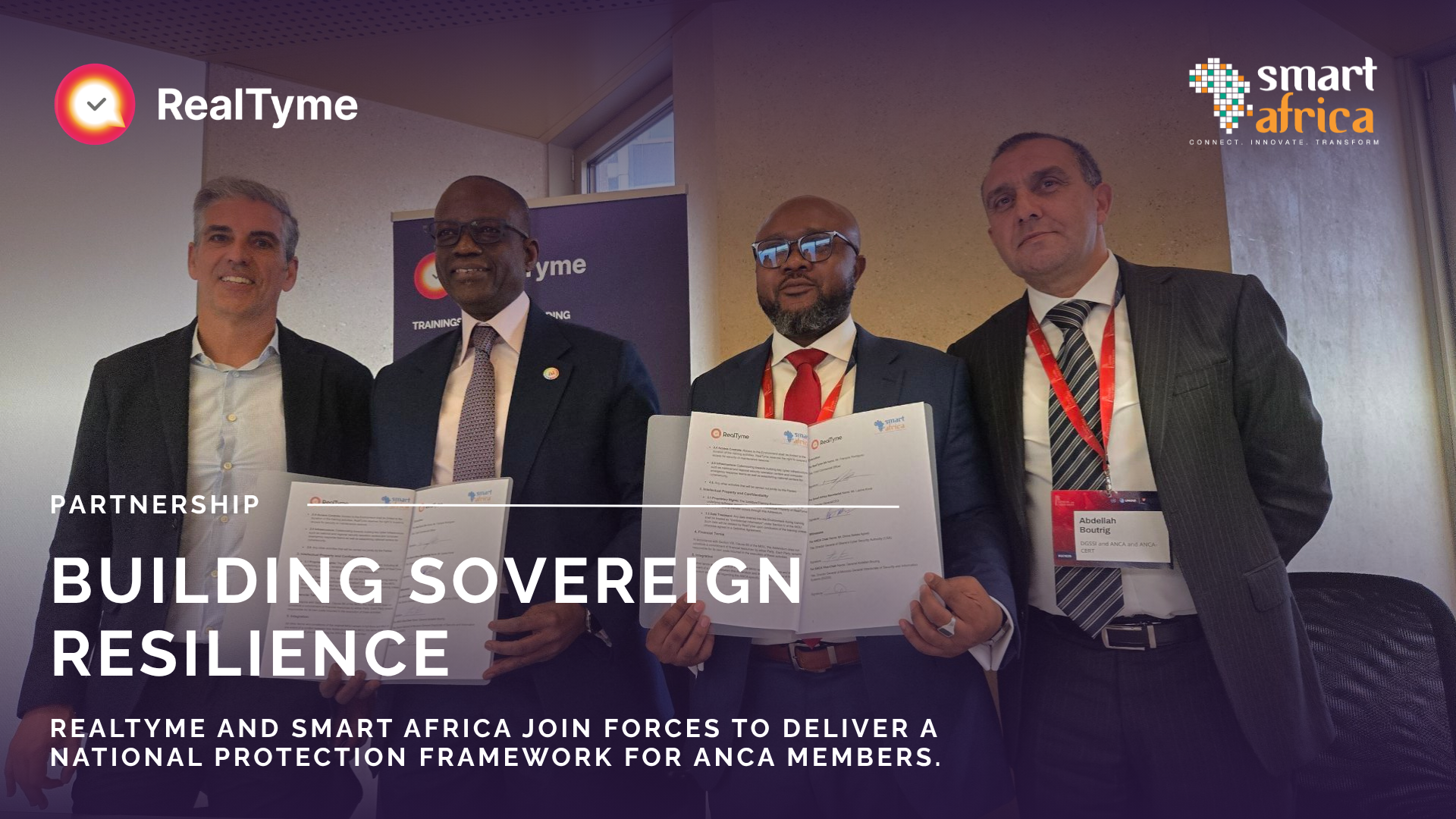
The ANCA partnership with RealTyme — announced at Geneva Cyber Week in May 2026 — is the clearest current example of this approach in action. Rather than a framework document or a memorandum of understanding, it is a time-bound operational programme structured around four concrete phases.
In the first 30 days, the Smart Africa Digital Academy (SADA) delivers targeted capacity building across digital sovereignty, post-quantum readiness, and Digital Public Infrastructure strategy. Deployment does not begin until the foundations are in place — a prerequisite too often skipped in technology partnerships.
By day 90, ANCA takes operational lead: selecting pilot countries through its member network, engaging the cross-ministry stakeholders whose buy-in is required, and deploying an initial sandbox for hands-on assessment. Pilot countries are identified through the network of member authorities, not chosen unilaterally.
By day 180, RealTyme deploys a fully sovereign sandbox in-country: hosted within national borders, under national jurisdiction, integrated with sovereign AI programs, digital identity systems, and existing Digital Public Infrastructure. National authorities hold their own cryptographic keys. The system is isolated, encrypted, and transparent by design.
Beyond 270 days, the programme moves to scale: best practices shared across the ANCA network, outcomes showcased at continental forums, multi-country rollout prepared. The lessons from pilot nations become the foundation for broader continental deployment.
The question ANCA applies when evaluating any partner is not whether the technology is technically impressive, but whether it can be deployed, operated, and sustained by a national authority under its own jurisdiction — and whether doing so genuinely advances that authority's sovereign operational capacity. Technology deployments that create sophisticated new dependencies reproduce the structural vulnerability they were meant to address. Sovereign deployments that build genuine in-country capability — even if slower and harder — produce outcomes that last.
That is the test worth applying to any sovereignty initiative. Not "does this give us access to better technology?" but "when the external partner leaves, do we control what remains?"
The Threat Environment: Why This Is Urgent, Not Optional
Understanding why digital sovereignty matters requires an honest look at the threat environment African governments currently face.
According to INTERPOL's 2025 Africa Cyberthreat Assessment Report, two-thirds of African member countries surveyed said that cyber-related crimes accounted for a medium-to-high share of all crimes, rising to 30% in Western and Eastern Africa. Online scams, phishing, ransomware, business email compromise, and digital sextortion are all widespread.
Eight African countries — Ethiopia, Zimbabwe, Angola, Uganda, Nigeria, Kenya, Ghana, and Mozambique — ranked among the top 20 most attacked nations globally in early 2025, with education, government, and telecommunications as the most targeted sectors.
The threat landscape is also evolving rapidly. In Africa's mobile-first economy, AI-generated deepfake fraud has become the fastest-growing threat category, with SIM-swap fraud alone costing South Africa over R5 billion annually. Meanwhile, cloud misconfigurations now account for 60% of incidents — the result of "permission drift" and unmonitored APIs rather than traditional malware.
Against this backdrop, the structural dependency of many African government systems on foreign infrastructure is not merely a policy concern. It is an active security vulnerability.
A government that does not control its own communications infrastructure cannot be certain those communications are secure. A government that does not manage its own encryption keys cannot guarantee the integrity of its data. A government without trained sovereign cyber capacity cannot respond effectively when — not if — an incident occurs.
Digital Sovereignty Is Not a Destination
The most important reframe for African governments thinking about digital sovereignty is this: it is not a threshold to cross, after which the problem is solved. It is an ongoing practice — of building and defending sovereign infrastructure, of training and retaining local talent, of managing cryptographic transitions as the threat environment evolves.
Post-quantum cryptography is the clearest illustration of this. Governments that achieve genuine infrastructure and cryptographic sovereignty today will still face the need to migrate their encryption to post-quantum standards within the next several years.
That migration is not a failure of the original sovereignty project — it is what maintaining sovereignty looks like over time. The governments best positioned to make it are the ones that already hold their own keys and operate their own systems, because they are the ones who can actually execute the transition when it comes.
Africa's digital transformation is moving fast. The threat environment is moving faster. The structural dependency of most African government digital systems on foreign infrastructure, foreign encryption, and foreign expertise is not a temporary condition that will resolve itself as the continent digitises — it will deepen unless deliberately addressed.
The good news is that the pathway is clearer than it has ever been. The tools exist. The institutional framework, in the form of ANCA and the Smart Africa Alliance, exists. The will, increasingly, exists. What remains is the sustained, unglamorous work of deployment — country by country, authority by authority, system by system. The failure mode of this work is rarely a bad launch — it is the absence of sustained follow-through. A workshop delivered, a framework handed over, and eighteen months later the situation on the ground has not materially changed. ANCA's phased, milestone-driven model exists precisely to prevent that — building accountability into the structure of every programme from the beginning, not as an afterthought.
Digital sovereignty means infrastructure you control, keys you hold, systems your people can operate, and the institutional capacity to defend all of the above.
Africa is building it. The question is only how fast.
Ready to explore what sovereign deployment looks like for your country? Talk to the RealTyme team or request a sovereignty audit.


.svg)
.svg)

.svg)
.svg)
