


Presentation

Post-Quantum Cryptography (PQC): Why CISOs Must Act Before 2030

Most CISOs today report green on cryptographic security. But that “green” status is based on encryption standards with a published expiry date. NIST has set it. Adversaries are already exploiting the gap through harvest now, decrypt later strategies. The choice is a decision about what “secure” is allowed to mean on your watch.

Deploy a PQC-Hardened NodeDownload the CISO Quantum Harvest guide
Free 14-day Demo
No credit card needed
No Setup
RealTyme's secure communication app displayed on a smartphone and desktop.


Harvest Now, Decrypt Later: Why Quantum Threats Are Already a Reality

The organizations collecting your encrypted communications today are not waiting for physics. They already have what they need. Quantum computing will only be the decryption event. The collection event is happening now — and it will not appear in any of your current threat monitoring.

Audit Your Cryptographic Risk

NIST Timeline: When Classical Encryption (RSA, ECC) Becomes Obsolete

NIST IR 8547 has set the schedule. Quantum-vulnerable algorithms — RSA, ECC, Diffie-Hellman — are deprecated after 2030 and disallowed after 2035. This is a regulatory countdown embedded in procurement, certification, and vendor requirements.

Your current cryptographic posture has a published expiry date. The only question is whether you will be protected before it — or scrambling after it.

Why Compliance Frameworks Do Not Protect Against Quantum Threats

Meeting SOC 2, ISO 27001, or NIS2 under classical encryption does not protect you from quantum risk.

These frameworks were written for a threat model that does not include a machine that breaks RSA in hours.

A certificate issued today is not a defense. It is a timestamp of what was acceptable before the physics changed.

The Risk of Delaying Post-Quantum Cryptography Migration

“We’ll migrate when the threat materializes.”

This is the most dangerous sentence in enterprise security today. By the time quantum capability is confirmed, the data has already been collected.

Migration at that point is not protection — it is damage assessment. If your data must remain confidential beyond 2030, the transition is already overdue.


How to Evaluate Quantum-Safe Encryption Vendors

The security market is saturated with quantum-adjacent language. "Quantum-ready." "Quantum-resilient." "Future-proof encryption." None of these phrases have regulatory definitions. None of them commit a vendor to anything. There are only two questions that matter:

Question 1 — Which NIST Post-Quantum Cryptography Standards Are Deployed?

NIST finalized post-quantum cryptography standards in 2024. There are three: FIPS 203 (ML-KEM) for key exchange, FIPS 204 (ML-DSA) for authentication, and FIPS 205 (SLH-DSA) as an alternative signature scheme. These are the only federally standardized PQC algorithms.

If your vendor cannot name these standards in verifiable technical documentation — not a blog post or sales deck — they have not deployed NIST-standardized PQC. They have deployed marketing language.

RealTyme implements ML-KEM-1024 (FIPS 203) and ML-DSA-87 (FIPS 204) at NIST Level 5 — the highest security tier — in production, not on a roadmap.

Question 2 — Who Controls the Encryption Keys and Jurisdiction?

Post-quantum mathematics is not sufficient if the encryption keys are held by a third party under a foreign jurisdiction. Legal access — through government orders, subpoenas, or provider-level access — can bypass even quantum-resistant encryption.

The location and control of your keys define who ultimately has access to your data. If those keys are not exclusively under your authority, encryption becomes conditional — dependent on external systems, jurisdictions, and policies outside your control.

Quantum-hardened security requires both the right algorithms and exclusive control over key custody. Without both, the protection is incomplete.

Read the Cryptographic Architecture Whitepaper →

What Quantum-Resistant Infrastructure Looks Like in Practice

We don't sell a future vision. We provide infrastructure that is operational today, within your specific jurisdiction, built on the standards that governments and businesses are already adopting.

Lattice-Based Cryptography vs Classical Encryption (RSA, ECC)

Post-quantum cryptography is not an upgrade of RSA. It is a different class of mathematics entirely.

RealTyme is built on lattice-based cryptography — a domain quantum algorithms cannot efficiently break. This is not stronger protection on the same terrain. It is protection on different terrain.

ML-KEM-1024 (FIPS 203) — quantum-resistant key establishment
✓ ML-DSA-87 (FIPS 204) — quantum-resistant authentication
✓ Hybrid model with classical layer — defense in depth
✓ No RSA or ECC in any active session path

Download the Cryptographic Architecture Whitepaper →

Cryptographic Agility: Adapting to Future PQC Standards

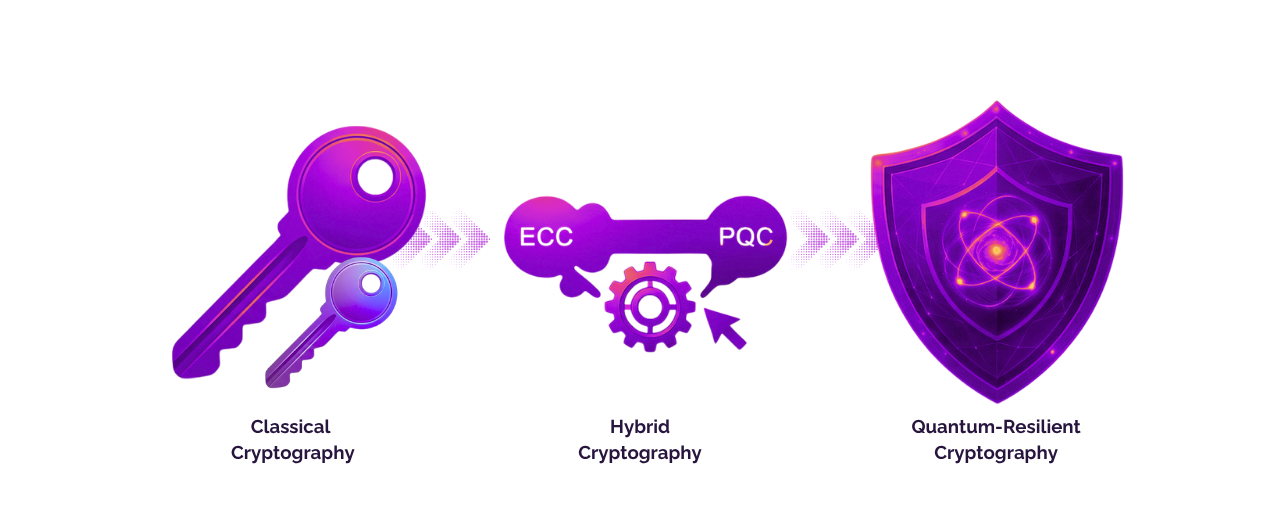
Most PQC deployments force a choice between classical and post-quantum.

RealTyme runs both simultaneously.Post-quantum and classical encryption operate in parallel for every session.

This ensures continuous protection — against today’s threats and tomorrow’s quantum attacks — without gaps during transition.

✓ Post-quantum and classical run simultaneously — not sequentially
✓ Breach requires independently breaking both layers
✓ Full protection during transition — no security gap
✓ Preserves end-to-end encryption guarantees

Data Sovereignty and Quantum-Safe Key Management

The threat landscape will keep shifting. NIST is already standardizing a fourth post-quantum algorithm — HQC, expected in 2027, using a code-based mathematical foundation as a backup to lattices. The organizations that deploy a static PQC solution today will need to rebuild again when the next standard arrives.

RealTyme is architected for cryptographic agility — the ability to swap algorithms through a policy update, not an infrastructure rebuild. When the next standard emerges, your posture advances. Your teams notice nothing. Your adversaries face a moving target.

You remain sovereign over your math. Not a hostage to it.

✓ Algorithm selection as a policy parameter, not hardcoded logic
✓ Independent upgrade paths for each cryptographic layer
✓ HQC adoption pathway already mapped
✓ No full system overhaul required when the next standard is finalized

Your Jurisdiction. Your Keys.
Your Rules.

Post-quantum cryptography solves the mathematical threat. It does not solve the legal threat.

PQC is only as effective as the jurisdiction it resides in. If your quantum-resistant infrastructure sits on a provider's cloud subject to foreign legal orders, you have solved the physics problem while leaving the legal door open.

The best algorithm in the world cannot protect data whose keys are held under someone else's law.
RealTyme closes both gaps simultaneously:

✓ On-Premises — your facilities, your jurisdiction, your law
✓ Sovereign Cloud — controlled infrastructure in your chosen country
✓ Swiss Cloud — outside Cloud Act reach, governed exclusively by Swiss law

Explore Deployment Options →


Your Teams Notice Nothing. Your Adversaries Face a Different Problem.

The question every CISO asks before any infrastructure change is the same: what breaks? The answer here is straightforward.

What Does Not Change

RealTyme remains end-to-end encrypted — the infrastructure can route data, but it cannot read content.
This does not change.
Zero Trust posture remains — every user, device, and connection continues to be verified continuously. PQC adds no new trusted components to the architecture.
Feature isolation remains — cryptographic contexts and keys stay strictly scoped by channel: messaging, calls, conferencing, sync. Each operates independently.
No new trust assumptions — deploying PQC does not introduce any new trusted infrastructure components, including relays or routing services.

What Changes

The mathematical foundation your adversaries face. Key establishment now includes post-quantum resilience that survives long-lived confidentiality requirements.
Authentication evolves toward post-quantum signatures — strengthening long-lived trust, including certificate-based deployments.
Your regulatory posture. From liability exposure to a defensible, documented migration position —with a cryptographic architecture verifiable by auditors and regulators.
The collection window closes. Data you send after deployment is protected against future quantum decryption. The adversary's archive stops growing.

Post-Quantum Cryptography Strategy: The CISO Decision Framework

The Legacy Approach
The Sovereign PQC Approach
Encryption Foundation
RSA/ECC - scheduled for deprecation
Lattice-based - NIST FIPS 203 & 204
Vendor Accountability
"Quantum-safe" - unverified marketing claim
FIPS 203, FIPS 204 - named, verifiable standards
Data Longevity Protection
Sensitive data with a 5-year shelf life is already a harvest target
Protected at point of ingestion - shelf life is irrelevant
Regulatory Trajectory
Depreciated 2030. Disallowed 2035. Personal liability risk rising.
Compliant with CNSA 2.0, EU roadmap, FIPS 140-3
Algorithm Flexibility
One migraton forces a full rebuild, Next standard forces another.
Cryptographically agile - swaps through policy, not engineering
Key Sovereignty
Provider-managed - subject to legal compulsion
Owner-managed - exclusively in your jurisdiction
Migration Mode
Crisis-driven, deadline-forced, under regulatory pressure
Planned, sequenced, completed before the window closes
Operational Impact
Zero disruption — until the deadline forces an emergency overhaul
Zero disruption — teams communicate exactly as today

Post-Quantum Cryptography Migration: Why Action Must Start Now

Every day of delay is another day of communications being collected. The organizations that act now will have closed the window before it matters. The ones that wait will be explaining the breach — to their board, to regulators, and under a personal liability framework that did not exist five years ago.

Deploy a PQC-Hardened NodeSchedule a Sovereignty Readiness Assessment


Frequently Asked Questions (FAQ)

How long does it take to deploy RealTyme's PQC infrastructure?

Deployment timelines depend on your environment — on-premises, sovereign cloud, or Swiss cloud. For most organizations, the PQC-hardened stack deploys in the same timeframe as a standard RealTyme deployment. There is no extended migration period, no phased algorithm cutover, and no disruption to existing users. Your teams are on quantum-resistant infrastructure from day one of deployment, not at the end of a multi-year transition program.

Does PQC affect the performance of calls, messages, or file transfers?

No. RealTyme's hybrid PQC implementation is optimized specifically to avoid performance degradation in real-time communication. Post-quantum key establishment adds negligible overhead to session initiation. Once a session is established, all messages, calls, and file transfers run on AES-256 symmetric encryption — which is unaffected by quantum computing and unchanged by the PQC layer. Your teams will not notice a difference in speed, latency, or usability.

What is the difference between PQC and Quantum Key Distribution (QKD)?

Post-quantum cryptography replaces mathematically vulnerable algorithms with new ones that quantum computers cannot break efficiently. It runs entirely on existing classical hardware and can be deployed across any network at any scale. Quantum Key Distribution uses quantum physics to detect eavesdroppers during key exchange — but requires dedicated optical fiber hardware and is currently limited to short-range, point-to-point links. PQC is the practical migration path for enterprise and government communication at scale. QKD is an additional layer for the most sensitive, fixed-infrastructure links where the hardware investment is justified.

We are already planning a security platform refresh. Should we wait and include PQC in that project?

No — and this is precisely the logic that creates HNDL exposure. The data being encrypted on your current platform today is the data at risk. Every month of delay between now and your platform refresh is another month of communications entering adversary archives under classical encryption. PQC migration does not need to wait for a platform refresh. RealTyme deploys as a sovereign, standalone infrastructure — it does not require replacing your existing stack first. The two can run in parallel during any transition.

What happens to data that was already encrypted before we deployed PQC?

Historical data encrypted under classical algorithms before your PQC deployment remains exposed to HNDL collection — this cannot be retroactively changed. That is precisely why the timing of migration matters. Data encrypted after deployment is protected by the hybrid PQC model. For organizations with highly sensitive historical archives, RealTyme's team can advise on re-encryption strategies for data at rest. The priority is stopping the growth of the vulnerable archive — which begins the moment you deploy.

Does RealTyme's PQC work across all deployment options — on-premises, sovereign cloud, and Swiss cloud?

Yes. The full PQC cryptographic stack — ML-KEM-1024 (FIPS 203) and ML-DSA-87 (FIPS 204) in a hybrid model with classical encryption — is available across all three hosting options. The deployment model does not affect the cryptographic architecture. Whether you deploy on your own infrastructure, in a sovereign cloud within your jurisdiction, or in the Swiss cloud, the mathematical protection is identical. What the deployment model determines is the legal jurisdiction governing your keys and data — which is the second half of the security equation.

How do I start a PQC migration assessment for my organization?

The first step is understanding where classical cryptography is currently embedded across your stack — a Cryptographic Bill of Materials (CBOM). RealTyme's engineering team offers a Sovereignty Readiness Assessment that maps your current cryptographic exposure, identifies the highest-priority migration targets based on data longevity and sensitivity, and produces a documented transition plan. This assessment is the foundation of a defensible migration program — the kind that stands up to regulatory scrutiny and board review. Schedule one using the link below.