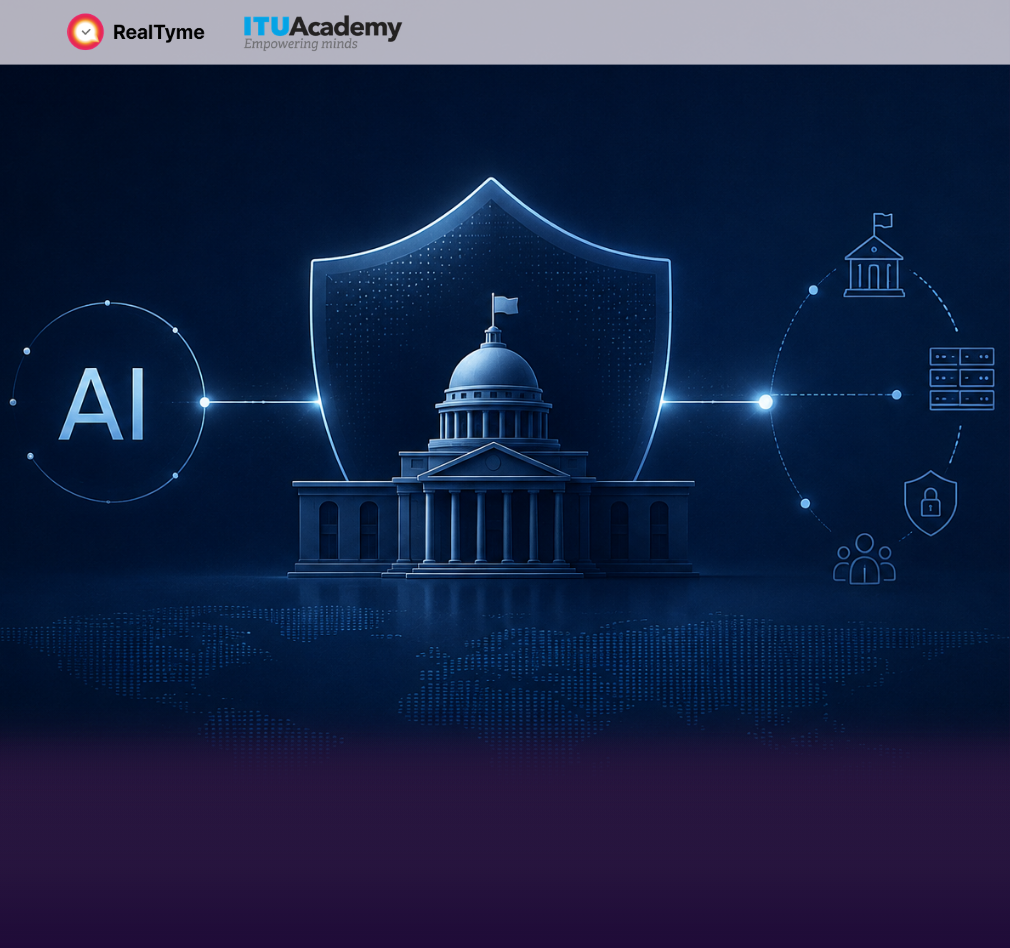
An introductory training course delivered in partnership with ITU Academy, developed by Cube Digital in cooperation with RealTyme. As governments rapidly adopt AI for dictation, transcription, translation, and document handling, most of these tools run in the public cloud — meaning sensitive voice recordings, draft communications, and classified-adjacent text routinely leave government custody. This course gives policymakers and government IT leaders the architectural literacy to specify, procure, and govern on-device AI, so sovereignty doesn't stop at the network and end at the model.
Course Description
Format: Online (webinar platform) or blended, instructor-led
Duration: 4 sessions x 2h each (8 hours total contact time)
Certificate: Certificate of completion
Region: Global (English; regional adaptations available — Session 4 includes region-specific material)
Cohort size: Maximum 40 participants per cohort, for interactivity
Course Objectives
1. Distinguish AI Architectures and Their Sovereignty Implications – Tell cloud, edge, and on-device AI apart in plain language, and understand why "sovereign AI" is an architectural claim, not a marketing one.
2. Apply a Structured Trust Framework – Use the Four Trust Models framework and a 10-question vendor checklist to evaluate any AI system, from any supplier, for government use.
3. Map AI Adoption to Regulatory Obligations – Connect AI use in official communications to NIS2, DORA, and sector-specific rules, and identify shadow-AI risk inside their own institutions.
4. Draft a Realistic Sovereign AI Pilot – Leave the course with a 12-month pilot plan for one real ministry workflow, ready to take back to their institution.
Who Should Attend
This course is designed for policymakers and ministry officials responsible for digital transformation or AI strategy, national cybersecurity authorities and CERT/CSIRT leadership, government CIOs, CISOs, and IT directors, procurement and compliance officers evaluating AI systems, and telecommunications and data-protection regulators. No technical background is required — every concept is taught in plain language.
Number of available places: 40 participants
Participants Will Explore
✅ The Architecture of Trust – Where AI actually runs, and why end-to-end encryption and cloud AI are structurally in tension. Includes the Zoom Paradox, the WhatsApp "Private Processing" case, and the OpenClaw exposed-agents incident.
✅ What Small Models Can (and Can't) Do – How small language models run entirely on-device, an honest capability assessment for government tasks, and why offline-capable AI matters for air-gapped, rural, and low-connectivity settings.
✅ The Shadow AI Problem – How sensitive text leaks into public chatbots inside ministries today, how NIS2 and DORA apply to AI in official communications, and a procurable vendor checklist for evaluating any "private AI" claim.
✅ From Policy to Deployment – A national readiness framework across infrastructure, skills, procurement, and regulation, plus the regional AI language gap (Arabic dialects, African language coverage), ending in a hands-on 12-month pilot plan.
Through live technology demonstrations, real-world case studies, interactive classification exercises, and a team capstone exercise, participants leave with take-away checklists and a workflow-ready sovereign AI pilot plan.
Program & Modules
1. Session 1 — Where AI Runs: The Architecture of Trust. The cloud-to-edge-to-device trust gradient; the Four Trust Models framework with a group classification exercise; the Zoom Paradox and E2EE-vs-cloud-AI case studies; live demonstration of on-device voice dictation.
2. Session 2 — Edge AI Explained: What Small Models Can (and Can't) Do. How small language models fit on everyday devices; the journey of a voice command through an on-device pipeline; a candid capability assessment; offline AI for air-gapped and defence settings, with a live sovereign transcription demonstration.
3. Session 3 — The Shadow AI Problem: Governance and Risk in Practice. How sensitive text leaks into public chatbots; mapping NIS2/DORA and sector rules to AI use in official communications; layered guardrails (OWASP LLM Top 10) and signed-model pledges; the 10-question vendor checklist, with a live demonstration closing the copy-paste loophole.
4. Session 4 — Sovereign AI Strategy: From Policy to Deployment. What "sovereign AI" really means and why architecture is the honest test; the regional language and capability gap; a national readiness checklist; capstone exercise drafting a 12-month pilot plan, with peer review and a live on-device classification demonstration.
Assessment and Certification
Attendance of at least three of the four sessions: required
Completion of the Session 4 capstone exercise (12-month pilot plan): required
Short final quiz (multiple choice) covering the core frameworks: required
Participants meeting these requirements receive a certificate of completion.
📨 Contacts
For any questions regarding the webinar content or enrollment, please reach out to us at: training@realtyme.com



.png)
.png)





.jpg)


.svg)
.svg)

.svg)
.svg)
