How Deepfake Attacks Are Targeting Executives — and How to Protect Leadership Communications

A deepfake executive attack uses AI-generated synthetic audio or video to impersonate a senior leader — such as a CEO or CFO — in order to deceive employees into transferring funds, revealing confidential data, or taking other harmful actions. These attacks require no technical breach and no malware; they exploit only human trust in familiar voices and faces. In 2024, engineering firm Arup lost $25.6 million in a single incident after a finance employee attended a video call in which every participant, including the CFO, was AI-generated. This is no longer a future threat. It is happening now, and it is targeting organisations like yours.
Deepfake fraud has evolved from a novelty into one of the fastest-growing enterprise risks of 2026. The tools required to clone a voice or generate a convincing video likeness are now accessible to anyone with a laptop and an internet connection. Attackers no longer need to breach firewalls, compromise credentials, or defeat endpoint security. They simply need to sound or look convincing — and then let human psychology do the rest.
This article explains how deepfake executive attacks work, who is most at risk, what the warning signs look like, and — most importantly — what practical steps organisations can take to protect their leadership communications today.
What is a deepfake executive attack?
A deepfake executive attack is a cyberfraud technique in which AI-generated synthetic media — audio, video, or both — is used to impersonate a specific senior leader with sufficient accuracy to deceive employees, partners, or government officials. Unlike traditional phishing, these attacks require no malware and no technical compromise. The attack vector is human trust itself.
Deepfake attacks against executives take three main forms:
- Voice cloning: AI replicates a specific person's voice from as little as 30 seconds of source audio, then uses it to make phone calls or send voice messages impersonating that person.
- Video deepfake: Pre-recorded or real-time AI-generated video places the target's face and voice into a fabricated scenario, most commonly a video call on platforms like Zoom or Microsoft Teams.
- Live real-time deepfake: The most advanced form — an attacker uses live face-swap and voice-cloning technology during an active video meeting, impersonating an executive interactively and in real time.
Executives are the primary targets because high-quality source material is freely available. Earnings call recordings, keynote presentations, LinkedIn videos, podcast interviews, and media appearances give attackers all the audio and video they need to build a convincing impersonation model.
How a deepfake attack actually unfolds: the anatomy of an attack
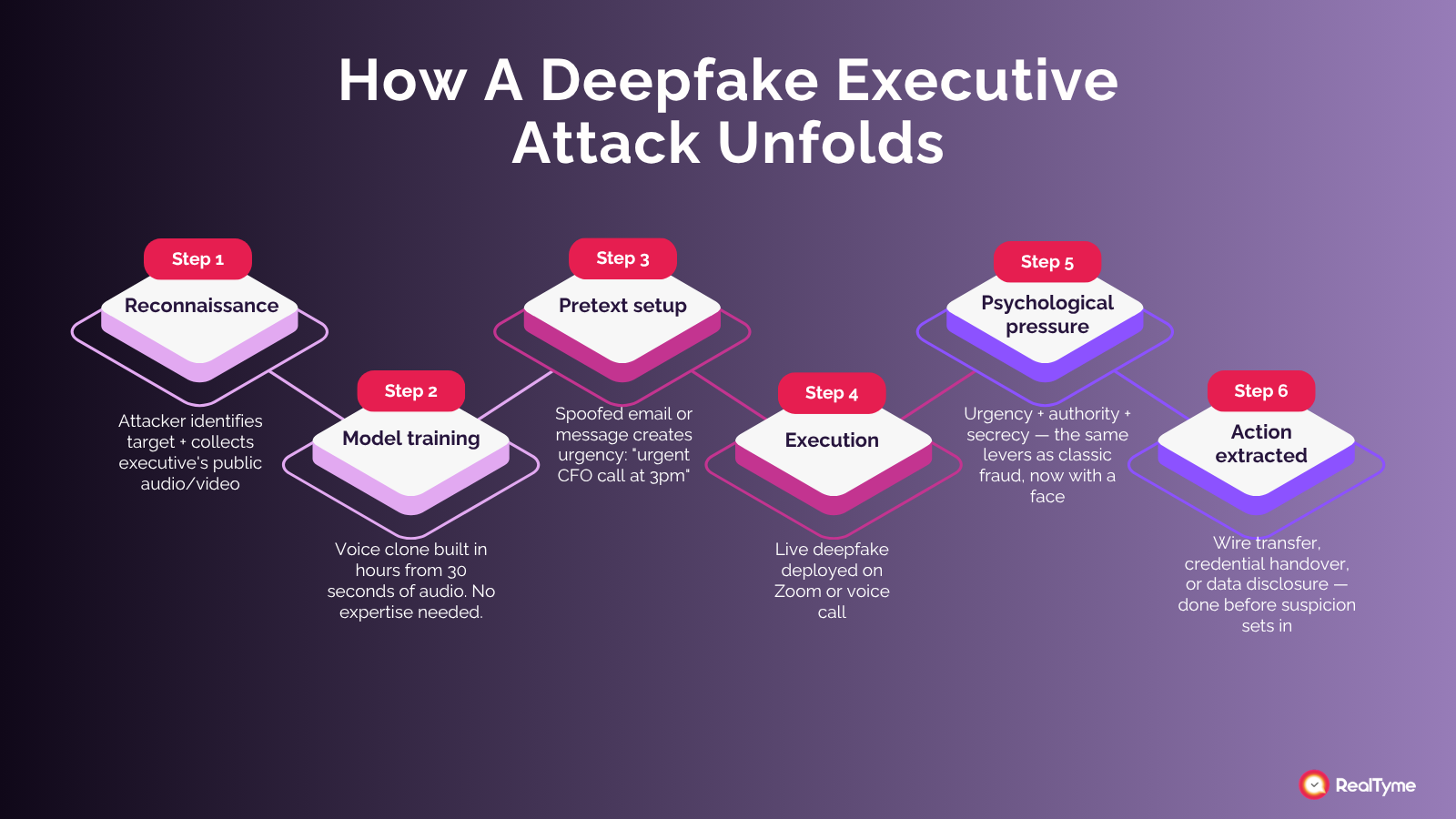
Understanding the attack sequence helps security and leadership teams identify the moments where defences can be inserted. A typical deepfake executive attack follows six stages:
1. Reconnaissance: The attacker identifies a high-value target within the organisation — typically a finance director, executive assistant, or senior operations manager who has both access and authority. They simultaneously profile the executive to be impersonated, collecting public audio and video material.
2. Model training: Using widely available AI tools, the attacker trains a voice and/or face model. Modern tools require only 30–90 seconds of clean audio for a convincing voice clone. Video models need a few minutes of well-lit footage. No specialist expertise is required.
3. Pretext setup: A spoofed email, calendar invite, or message is sent to the target creating context for the upcoming call. "Urgent call with the CFO at 3pm regarding a confidential acquisition" is a common framing.
4. Execution: The deepfake is deployed during a live video or voice call. The attacker maintains the impersonation for only as long as necessary to issue the instruction.
5. Psychological pressure: The attacker applies the same psychological levers as classic social engineering: urgency, authority, and secrecy. The difference is that these levers are reinforced by visual and audio "proof" of identity.
6. Action extracted: The target executes a wire transfer, surrenders login credentials, shares sensitive documents, or takes another harmful action — believing they have received a legitimate instruction from a trusted leader.
What makes this threat uniquely dangerous is the human detection gap. Research published in 2025 found that humans correctly identify high-quality deepfake video only 24.5% of the time — barely better than random chance. A 2025 iProov study found that only 0.1% of participants correctly identified all fake and real media presented to them.
Three real-world cases that changed how organisations think about executive security
These are not hypothetical scenarios. Each of the following incidents is verified and documented.
Case 1: Arup, Hong Kong — $25.6 million lost (2024)
A finance employee at the global engineering firm Arup received what appeared to be a routine meeting invitation from the company's UK-based CFO. When they joined the video call, the CFO was there — as were several other colleagues.
All of them were AI-generated deepfakes. During the call, the "CFO" instructed the employee to execute 15 separate transactions totalling HK$200 million ($25.6 million USD) to five different bank accounts. The employee complied. The fraud was only discovered during a follow-up call with the real CFO. No funds were recovered.
Lesson: Deepfakes can populate an entire meeting. The presence of multiple "known" faces reinforces the deception.
Case 2: Ferrari — attack foiled by personal verification (2024)
An attacker cloned the voice of Ferrari CEO Benedetto Vigna with striking accuracy, replicating his distinctive southern Italian accent. The fabricated voice contacted a senior Ferrari executive via WhatsApp, referencing a confidential acquisition and requesting an urgent NDA signature and financial transaction.
The attempt failed when the executive challenged the caller with a personal question — the title of a book Vigna had recently recommended. The attacker could not answer. The call ended immediately.
Lesson: Human verification protocols work — but only if they exist before an attack occurs.
Case 3: Singapore multinational — $499,000 lost (March 2025)
A finance director at a multinational firm based in Singapore authorised a $499,000 USD wire transfer during what appeared to be a legitimate Zoom call with the company's CFO and senior leadership team. Every participant on the call was AI-generated.
No technical compromise was involved — no malware, no phishing link, no credential theft. The only attack surface was human trust in a video interface.
Lesson: Regulated industries and government-adjacent organisations are equally exposed. Consumer-grade video platforms offer no identity verification whatsoever.
Why government and regulated industries face higher risk
While any organisation can be targeted, government institutions and regulated industries — defence, finance, energy, healthcare — face a compounded set of risks that make them disproportionately attractive to attackers.
- Ministers, agency heads, cabinet officials, and senior regulators have extensive public media archives: parliamentary speeches, press conferences, formal interviews, and public hearings. This material is ideal training data for deepfake voice and face models.
- Government communications frequently cross multiple insecure channels. Convenience drives the use of consumer messaging apps like WhatsApp and standard Zoom accounts for sensitive discussions — channels with no verified identity, no audit trail, and no sovereignty.
- In regulated industries, a single fraudulent instruction attributed to a senior executive can authorise the movement of millions, unlock classified systems, or trigger irreversible operational decisions.
- Cross-border and remote teams cannot physically verify identity. The pandemic normalised video-based authority — and attackers have weaponised that normalisation.
- Political deepfakes are already widespread. Researchers documented over 100 deepfake video advertisements impersonating a sitting UK Prime Minister on a single social media platform within a single month — illustrating the scale at which political figures can be synthetically replicated.
- Under the NIS2 Directive, which came into force in December 2025, organisations operating critical infrastructure are legally required to ensure their communication networks meet current security standards. Routing sensitive communications through unverified consumer platforms is not just a security risk; it is a compliance exposure.

5 warning signs that a communication may be a deepfake
Given that human visual detection of deepfakes is unreliable, the most practical defences are procedural rather than perceptual. However, these technical indicators can serve as early warnings:
1. Unscheduled urgency: A surprise request for an urgent financial action, sensitive data disclosure, or confidential decision from a leader who has not communicated through verified channels. Legitimate executives rarely issue high-stakes instructions via impromptu video calls with no paper trail.
2. Unnatural facial synchronisation: Subtle lip-sync delays, inconsistent blinking patterns, facial edges that blur or distort when the person moves quickly, or lighting that does not match other participants on the same call.
3. Audio anomalies: An unnaturally flat tonal range, slight background processing artefacts, or a voice that lacks the micro-variations of natural human speech. Real-time voice cloning still introduces subtle inconsistencies.
4. Requests for secrecy: "Don't tell anyone else about this call" or "this needs to stay between us" are classic social engineering flags. Legitimate executives operating within proper governance structures do not instruct employees to conceal decisions.
5. Inability to answer personal verification questions: As the Ferrari case demonstrated, an AI impersonation model cannot answer questions that require genuine shared history. Pre-agreed personal challenge questions are a reliable real-time defence.
How to protect leadership communications: 6 practical defences
Visual detection is an unreliable defence. Structural, protocol-based, and platform-level defences are far more robust. Here are six measures that security and leadership teams should implement:
1. Use a verified-identity communications platform
Consumer applications — WhatsApp, standard Zoom, FaceTime — offer no cryptographic identity verification. Any participant can join with any identity.
Leadership communications must take place on platforms that verify participant identities at the platform level, using digital signatures and public key cryptography, before a session is established. This eliminates the core attack surface: the ability to impersonate an executive on a call.
RealTyme is built for exactly this requirement. It performs mutual authentication through digital signatures and public key cryptography between every application and server — so each participant's identity is cryptographically confirmed before a single word is exchanged. Unlike WhatsApp or standard Zoom, it is engineered specifically for executives, government teams, and regulated industries where impersonation is not a theoretical risk but an active threat.
2. Establish out-of-band verification protocols
Any financial instruction, sensitive data request, or unusual directive delivered via video or voice call must be confirmed through a second, independent channel before any action is taken.
The confirmation channel should be one the original caller cannot intercept or impersonate. This single measure would have prevented the Arup and Singapore incidents.
3. Implement knowledge-based authentication for high-stakes decisions
Pre-agree a small number of personal challenge questions between executives and their direct teams — questions whose answers cannot be found in any public record or AI training dataset. Deploy these at the beginning of any call involving financial authorisation or sensitive decisions. Ferrari's executive used exactly this approach.
4. Move leadership communications to sovereign-hosted infrastructure
If your organisation's most sensitive communications are routed through a foreign cloud provider's infrastructure, they are governed by foreign law and potentially accessible to state-level interception.
Beyond eavesdropping risk, this data may also be harvested and used to train AI models — including the same deepfake models that will later be used to impersonate your leadership. Sovereign-hosted or on-premise deployment eliminates this exposure.
5. Reduce the public media footprint of senior leadership.
Every high-quality audio or video recording of an executive published online is potential training data for an attacker's impersonation model.
This does not mean eliminating public communications, but it does mean being deliberate: avoid publishing long, high-quality, uncompressed audio or video recordings where possible, and watermark official media.
6. Train leadership and their teams through simulated deepfake exercises
Tabletop exercises and simulated deepfake call scenarios build the verification instinct before a real attack occurs.
Teams who have experienced a simulated deepfake call are significantly better equipped to identify and challenge suspicious communications under real pressure.
What to look for in a secure executive communications platform
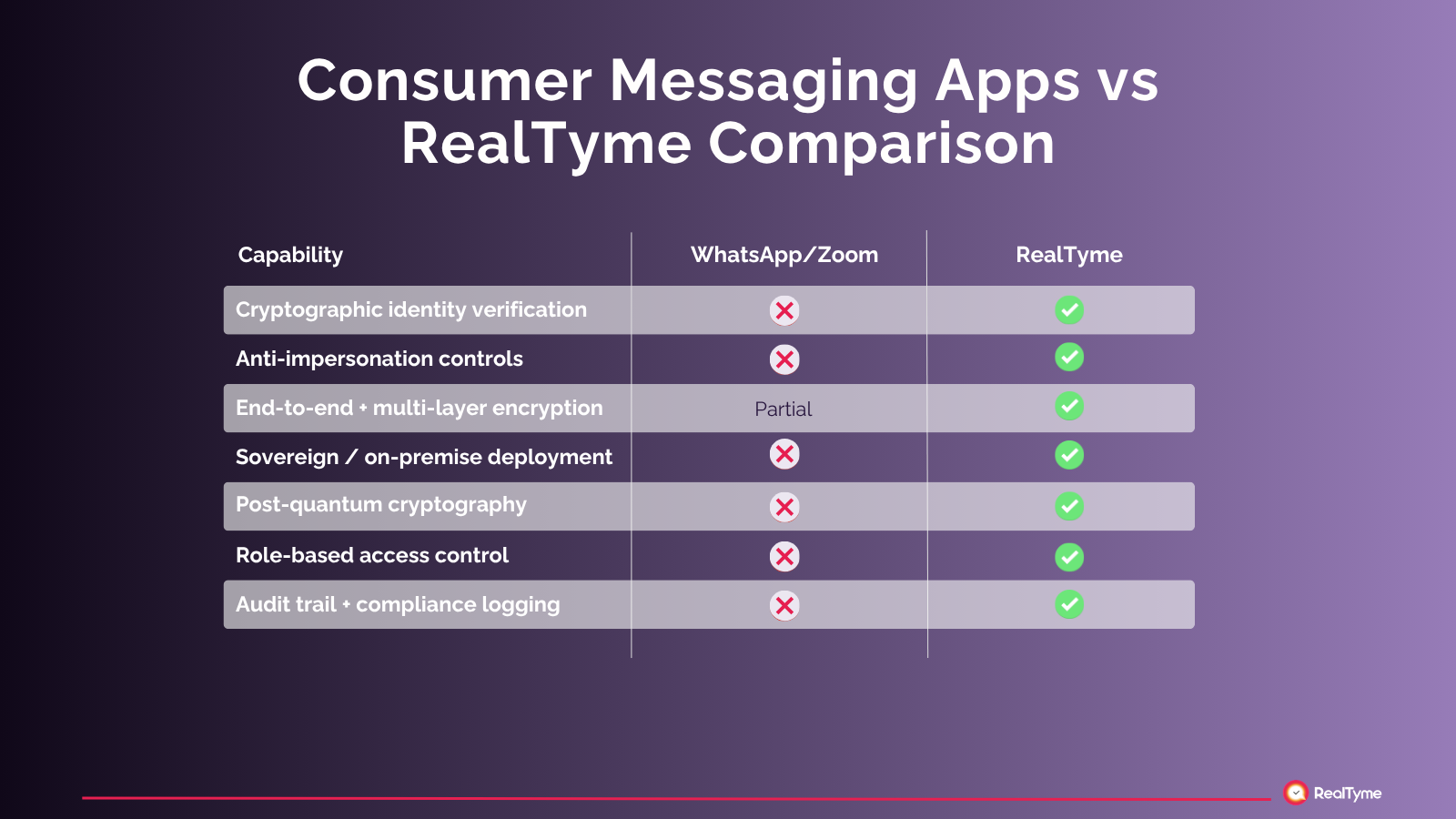
Not all "secure" communications tools are equal. When evaluating a platform for executive and government leadership use, the following capabilities are non-negotiable:
- Cryptographic identity verification: Every session participant must have a verified digital identity backed by public key cryptography — not just a username and password. This is the foundational control that prevents impersonation at the platform level.
- Multi-layer end-to-end encryption: Messages, calls, and files should be encrypted end-to-end between devices, with additional client-to-server and transport layer encryption. No single point of failure should expose communications.
- Anti-impersonation controls: The platform should enforce verified identity at session initiation, preventing unauthorised users from joining as someone else — regardless of how convincingly they can mimic that person's voice or face.
- Sovereign or on-premise deployment: Data must remain under your organisation's legal jurisdiction and physical control. Platforms hosted on foreign cloud infrastructure expose communications to third-party legal access and interception risk.
- Post-quantum cryptography readiness: Encryption standards are evolving. A platform built for governments and regulated industries should already be transitioning to post-quantum cryptographic standards that will remain secure as quantum computing matures.
- Role-based access and clearance control: Leadership communications should be accessible only to participants with the appropriate role, clearance level, or explicit authorisation. Granular access control prevents lateral exposure.
- Operational continuity under disruption: Mission-critical communications platforms must remain operational during network disruptions, cyberattacks on broader infrastructure, or targeted interference. Air-gapped or offline-capable deployment options are essential for government and defence use cases.
RealTyme meets all seven of these requirements by design — with sovereign deployment, post-quantum readiness, and cryptographic identity verification built into the platform architecture from the ground up, not added as an afterthought.
The voice of authority is now a vulnerability
Deepfake executive attacks represent a fundamental shift in the threat landscape. For decades, securing an organisation meant securing its systems, its networks, and its data.
Today, attackers bypass all of that by simply impersonating the people your team trusts most. The Arup incident, the Ferrari attempt, the Singapore transfer — these are not isolated anomalies. They are the early cases of an attack category that is growing in frequency, sophistication, and scale.
The organisations that will avoid becoming the next case study are those that treat leadership communications as critical infrastructure: protected by verified identity, encrypted at every layer, hosted under their own sovereign control, and governed by protocols that require human verification before consequential decisions are executed.
Protect your leadership communications with RealTyme
RealTyme gives executives and government teams a communications environment where every identity is cryptographically verified, every message is end-to-end encrypted, and no conversation can be intercepted or impersonated. Sovereign deployment. Post-quantum ready. Built for decision-makers.
See how RealTyme protects leadership communications
Frequently asked questions
What is a deepfake executive attack?
A deepfake executive attack is a cyberfraud technique where AI-generated synthetic audio or video is used to impersonate a senior leader — such as a CEO or CFO — in order to deceive employees into transferring funds, sharing confidential data, or taking other harmful actions. These attacks require no technical breach; they exploit human trust in voices and faces. The most sophisticated versions use live, real-time deepfake technology to impersonate executives interactively during video calls.
How much money have deepfake executive attacks cost organisations?
Losses are substantial and accelerating. In one 2024 incident, the global engineering firm Arup lost $25.6 million after a finance employee was deceived by a fully AI-generated video call impersonating the CFO and multiple colleagues. In a separate 2025 case, a Singapore-based multinational lost $499,000 in a similar attack. By Q2 2025, global damages from deepfake fraud incidents had reached $350 million in a single quarter, according to Resemble.ai.
Can you detect a deepfake video call in real time?
Human detection of high-quality deepfake video is highly unreliable — studies show an average human detection accuracy of only 24.5%, barely above chance. Detection software exists but is imperfect and not yet suitable for real-time deployment in most organisations. The most reliable defences are procedural: always verify high-stakes requests through a second independent channel, use pre-agreed personal challenge questions, and deploy communications platforms with cryptographic identity verification so that impersonation is structurally impossible at the platform level.
Are government officials and public sector leaders at higher risk from deepfakes?
Yes. Government officials, ministers, and public sector executives are particularly vulnerable because extensive public audio and video archives — parliamentary speeches, press conferences, formal interviews — provide attackers with ideal training material for voice and face cloning models. Researchers documented over 100 deepfake video advertisements impersonating a sitting UK Prime Minister on a single social platform within a single month, demonstrating the scale at which political figures can be synthetically replicated.
How does a secure communications platform protect against deepfake attacks?
A purpose-built secure communications platform reduces deepfake risk structurally by ensuring every session participant has a cryptographically verified identity before joining a call. This means attackers cannot simply impersonate an executive, regardless of how convincingly they can replicate their voice or face. Platforms with sovereign hosting also prevent leadership communications from being intercepted or harvested by third parties — including for use as AI training data. Verified identity at the platform level — as delivered by RealTyme — is the defence that visual recognition alone cannot provide.


.svg)
.svg)

.svg)
.svg)
