Trust, Not Intelligence: Why 2026 Became the Year Governments Stopped Trusting AI They Couldn't Control

For most of the last decade, secure communications for governments meant picking a messaging app with strong encryption and calling it done. In 2026, that assumption stopped holding. SignalGate — where sensitive government discussions ended up on a consumer messaging app never built for state-level security — made painfully clear that convenience tools and national-security-grade communication are not the same category of product, no matter how good their encryption is on paper.
The deeper problem SignalGate exposed isn't really about one app. It's about who controls the platform underneath it — and what happens when that control sits somewhere outside the government using it. That question got a second, sharper illustration a few months later: in June 2026, Anthropic suspended access to two newly launched AI models worldwide after a U.S. export-control directive made continued access non-compliant, restoring it three weeks later once the controls were lifted (Anthropic's own account of events). Nobody using those models did anything wrong. They found out, in real time, that a foreign regulatory decision could reach into their workflow and switch part of it off — the same exposure SignalGate revealed, just one layer up the stack.
Two different incidents, one shared lesson: if you wouldn't run classified conversations through a consumer chat app, you shouldn't run sensitive government communications — or the AI processing layered on top of them — through infrastructure you don't control and can't audit.
RealTyme was built specifically to be the alternative: sovereign, end-to-end encrypted communications with on-device AI, already operational with government agencies, ministries, and defense organizations, long before "sovereign AI" became a headline.
The Data Behind The Shift
This isn't sentiment — it shows up in the numbers, and it shows up fast.
- More than 90 countries now have formal digital sovereignty statements in place, which analysts at TBR read as sustained policy momentum rather than a passing trend — a theme that dominated Mobile World Congress 2026 alongside AI itself.
- Executives and policymakers increasingly point to data sovereignty, accountability, and auditability — not raw model capability — as the primary risk in AI adoption.
- The 2026 VivaTech Confidence Barometer found that while 9 out of 10 executives say they trust AI, 4 out of 10 admit they've already shared confidential data with tools they didn't fully trust. Confidence and caution are rising at the same time, in the same organizations.
Put together: adoption is accelerating and anxiety about control is accelerating right alongside it. That gap — between "we're using this" and "we don't fully trust it" — is exactly the space sovereign infrastructure is being built to close.
The Middle East and Africa Are Where This is Moving Fastest
While Europe has spent years debating what digital sovereignty means in policy terms, the Middle East and Africa are treating it as an infrastructure build-out happening right now.
The Gulf is deploying, not just debating.
The MEA cloud infrastructure services market is projected to grow from roughly $11.8 billion in 2025 to $26.4 billion by 2031, a sustained double-digit CAGR, with profit pools shifting toward AI-ready compute and sovereign cloud specifically as governments push data-residency requirements.
The UAE has moved fastest from policy to production: building on its AI Charter, Abu Dhabi launched a unified sovereign cloud environment processing more than 11 million daily digital interactions across government services, alongside stepped-up enforcement against deepfake misuse. Other Gulf governments are building comparable sovereign cloud models of their own, treating data the way the region has historically treated energy — a strategic resource to control, not outsource.
Egypt is positioning itself as the regional hub.
Egypt is pursuing an integrated digital sovereignty strategy combining policy, technical readiness, and infrastructure investment, with officials explicitly framing digital sovereignty as a cornerstone of national security and economic continuity — comparing data centers today to what ports and airports were to the last century's economy.
North and West Africa are following the same script.
Morocco's GITEX Africa 2026 placed AI, cybersecurity, and technological sovereignty at the center of the continent's digital agenda, while regional leaders at the SAMENA Telecommunications Council Leaders' Summit in Dubai framed sovereignty in explicitly practical terms — the ability of nations to make free, secure, strategic decisions about their own digital systems, backed by policy and regional cooperation rather than left as rhetoric.
This is a region where sovereignty isn't a slide in a policy deck. It's a procurement decision being made this budget cycle.
What "Sovereign" Actually Has to Mean
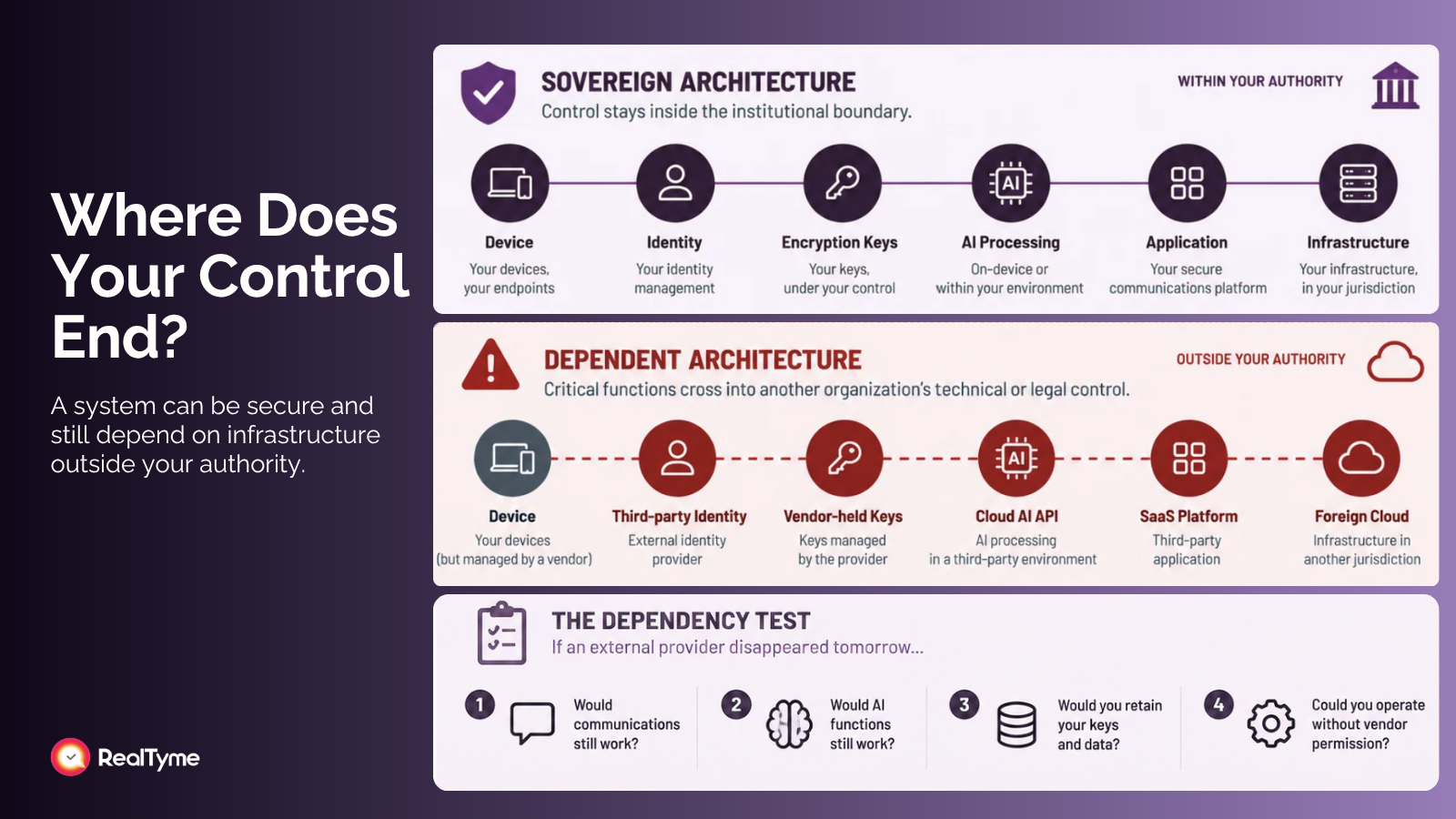
The word gets used loosely — plenty of vendors will call a product "sovereign" because it has a European or Gulf data center. For a defense agency, regulated enterprise, or government agency evaluating due diligence, sovereignty only means something if it holds up against a short list of hard requirements:
1. Jurisdictional data residency — data physically stays within approved borders, not just "compliant on paper."
2. No foreign kill-switch exposure — the platform can't be disabled or degraded by a regulatory directive from a government you don't answer to.
3. Auditable, not just described — access, model behavior, and data flows can be reviewed on demand, not taken on trust.
4. Cryptographic control that stays local — encryption keys and identity infrastructure are held by the institution, not a foreign vendor's cloud.
5. On-device / edge processing where it matters — sensitive AI functions (transcription, translation, redaction) run without sending raw data outside the organization's own boundary.
6. Post-quantum readiness — encryption designed to hold up once quantum computing makes today's standards breakable, not retrofitted later under pressure.
Anything short of that is a sovereignty claim on a slide, not sovereign architecture in production. Where exactly does your control end? Broken down by technical layer, that same distinction looks like this:
How RealTyme Answers Each of These
Most vendors will nod along to all six requirements above. What separates a real answer from a marketing slide is whether each one holds up to a specific question, so it's worth walking through what each actually looks like on RealTyme's sovereign platform.
On data residency, the platform is deployable either on-premise or inside a sovereign cloud environment the customer selects — meaning the institution decides where its data physically sits, rather than accepting wherever a vendor's default infrastructure happens to be hosted. That distinction matters more than it sounds: plenty of "sovereign" platforms are still built on a single vendor's global cloud with a regional data center bolted on, which solves the geography problem but not the control problem.
Control is really the second requirement, and it's architectural rather than contractual. RealTyme keeps the application software, the admin console, and the hosting itself under the customer's own control rather than a third party's — so there's no single point where an outside company, or a government with jurisdiction over that company, could restrict or degrade the service. That's the practical difference between a platform that's merely hosted for a government and one that's operated by it.
Auditability shows up in who's already trusted the platform enough to run it: RealTyme is operational with government agencies today, and procurement processes at that level don't take a vendor's word for security claims — they require the kind of verification, review, and ongoing access to system behavior that this article's third requirement describes. A platform that can't stand up to that level of scrutiny doesn't get through that door in the first place.
Cryptographic control is where end-to-end encryption and metadata handling come in. The platform is built so that no metadata leaks in the course of normal use, and encryption keys and identity infrastructure stay with the institution rather than passing through, or being held by, an outside party. That's a meaningfully different design decision than encrypting content while still generating and storing metadata about who talked to whom, when, and how often — metadata that, on its own, can reveal almost as much as the message content it's protecting.
The on-device requirement is answered by where the AI actually runs. Functions like transcription, translation, smart reply, and redaction are processed on-device, which means the sensitive content those functions touch — a transcribed conversation, a translated document, a redacted file — never has to leave the organization's own boundary to be processed by a model sitting on someone else's server.
And on post-quantum readiness, the encryption is built quantum-ready now rather than treating the eventual migration as a future project. Given how long government and defense deployments stay in service, encryption chosen today needs to survive advances in computing that haven't happened yet — retrofitting that later, under pressure, after quantum-capable decryption becomes practical is a much harder and riskier position to migrate from than building it in from the start.
Questions Worth Asking Any Sovereign Communications Vendor
Reading through claims like these is one thing; testing them is another, and the two don't always match. A handful of direct questions tend to separate a genuinely sovereign platform from one that's simply adopted the vocabulary.
The first is whether the vendor can actually show you the admin console and hosting are under your control right now, in the deployment you'd be running, rather than pointing to a roadmap item or an enterprise-tier feature that isn't live yet.
The second is where encryption key management physically happens and who, specifically, has the technical ability to access those keys — not who's contractually forbidden from accessing them, but who could.
The third is which AI functions process data on-device versus sending it to a server, and if it's the latter, exactly where that server sits and under whose jurisdiction.
The fourth, and probably the most uncomfortable one to ask, is what would happen to your specific deployment if the vendor's home country issued an export-control order or sanction affecting their technology tomorrow — would anything about your access, your data, or your service continuity actually change.
The fifth is whether you, the customer, would be allowed to run your own penetration test against your own instance, and whether the vendor treats that as a normal request or a hostile one.
And the sixth is whether post-quantum encryption is already implemented or still a slide in a future roadmap — the honest answer to that question alone tells you a great deal about how seriously "sovereign" is being taken versus how well it photographs in a sales deck.
Every one of those questions maps directly back to the six requirements above, and a vendor's willingness to answer them plainly, without deflecting into generalities, is itself part of the answer.
Where This Leaves Government and Defense Buyers
The uncomfortable truth for a lot of institutions is that most of what they're using today — commercial messaging apps, general-purpose AI assistants, foreign-hosted cloud tools — was never built to meet that list. It was built for consumers, then adapted for enterprise, then adapted again for government. Retrofitted compliance is not the same as sovereign-by-design.
RealTyme's platform was built the other direction: end-to-end encrypted collaboration with on-device AI, designed from day one for governments, defense agencies, and regulated enterprises, not adapted after the fact.
If you're assessing where your own communications and AI stack stands against the six requirements above, our Infrastructure Assessment and Sovereign Capacity Building programs are built specifically to answer that question — starting with an audit of where control actually sits today.
FAQ
What does "sovereign AI" mean for governments?
It means an institution controls the infrastructure its AI and communications run on — data residency, encryption keys, auditability, and operational continuity — rather than depending on a foreign commercial provider that can restrict or withdraw access unilaterally.
Why did AI sovereignty become urgent in 2026?
In June 2026, a U.S. export-control directive forced a major AI provider to suspend access to two newly launched models worldwide, then restore it weeks later once the controls were lifted. The episode showed that dependence on foreign-controlled AI carries real operational risk, not just theoretical policy risk.
Which regions are investing most in sovereign infrastructure right now?
The Middle East and Africa currently show some of the fastest cloud-infrastructure growth globally, with the market projected to more than double from roughly $11.8 billion in 2025 to $26.4 billion by 2031, driven by government programs in the UAE, Qatar, Saudi Arabia, and Egypt.
Is WhatsApp or Signal secure enough for government communications?
Increasingly, no. Incidents like SignalGate and the rise of purpose-built sovereign platforms show that consumer-grade encrypted apps, however good for personal use, weren't designed for classified or national-security-grade communication.
How do you evaluate whether a communications platform is actually sovereign?
Check whether the admin console and hosting are genuinely under the customer's own control, where encryption key management physically happens, which AI functions process data on-device versus on an external server, and whether post-quantum encryption is already implemented rather than planned. A vendor that can answer all four plainly, without pointing to a future roadmap, is the one actually building sovereign architecture rather than describing it.


.svg)
.svg)

.svg)
.svg)
