How to Embed Digital Sovereignty in Government Communications

Key Takeaways
- Digital sovereignty ensures governments maintain control over data, communications systems, and digital infrastructure.
- Secure government communications are critical for emergency response, policy coordination, and citizen data protection.
- Achieving digital sovereignty requires a combination of technical safeguards, governance frameworks, and cybersecurity culture.
- Technologies such as zero trust architecture, end-to-end encryption, and AI-driven threat detection help strengthen sovereign government communications.
- Governments must design workflows that ensure data residency, regulatory compliance, and operational resilience.
In today’s increasingly connected world, governments rely on digital communication systems to coordinate operations, share sensitive information, and respond to emergencies. From inter-agency collaboration to citizen services and crisis management, secure and reliable communication infrastructure is essential for effective public administration and public-sector cybersecurity.
Every day, critical decisions, emergency alerts, and sensitive policy discussions flow through digital channels that must remain secure, reliable, and under the organization’s control.
But pause for a moment: Who truly controls this information? Are our systems resilient enough to withstand a sophisticated cyberattack, a network failure, or even a simple human mistake? Can we guarantee that sensitive data never leaves the jurisdiction it’s meant to stay in?
This is where digital sovereignty comes in. It’s not a buzzword. It’s the ability to govern, secure, and maintain control over your organization’s communications and data. Achieving it requires asking the hard questions, implementing robust safeguards, and ensuring that every workflow, message, and decision remains trusted, uninterrupted, and accountable, even in the face of growing cyber threats.
This article explains what digital sovereignty means for governments, why secure communications are critical for public-sector resilience, and how agencies can embed sovereignty into their digital workflows.
What is Digital Sovereignty in Government?
Have you ever asked yourself: Who really controls your organization’s data? Where does it live, and who can access it?
Digital sovereignty is the ability of a government or public-sector organization to maintain full control over its digital infrastructure, communications systems, and data according to national laws, security policies, and regulatory frameworks. It ensures that sensitive government information remains protected, accessible, and governed within the appropriate jurisdiction.
Closely linked is data sovereignty, which focuses specifically on where data is stored, processed, and transmitted, and under which legal framework. Together, digital and data sovereignty ensure that governments can:
1. Keep critical communications under control, from emergency alerts to sensitive policy deliberations.
2. Stay compliant with national and international regulations like GDPR, ISO standards, or NIST frameworks.
3. Shield operations from external interference or unauthorized access.
4. Maintain operational resilience even if external systems fail or foreign cloud providers introduce risks.
Digital sovereignty is a strategic mindset, a combination of policy, governance, culture, and technical safeguards. It’s about asking the hard questions:
- Are our workflows truly secure?
- Could sensitive data accidentally leave the country?
- Are we prepared for a cyberattack that targets communication integrity?
When digital sovereignty is embedded effectively, governments don’t just protect information, but they protect trust, continuity, and the ability to act decisively when it matters most.

Why Is Digital Sovereignty Important for Governments?
Digital sovereignty is essential for governments because it ensures that sensitive public-sector data, communications, and decision-making processes remain protected under national jurisdiction.
Without sovereign control over digital systems, governments risk exposing critical information to foreign legal frameworks, cyber threats, and operational disruptions. Maintaining digital sovereignty strengthens national security, protects citizen data, and ensures continuity of government operations during crises.
Why Government Communications Must Be Sovereign
The consequences of insecure government communication are far-reaching. A compromised communication channel can delay emergency responses, leak sensitive policy deliberations, or expose citizen data. Beyond operational disruptions, security failures erode public trust. Citizens expect that governments can safeguard not just their personal information, but also the integrity of decisions affecting their lives.
The challenges are compounded by a rapidly evolving digital landscape. Governments often rely on a mix of legacy platforms, cloud services, and third-party tools, creating fragmented workflows that are difficult to control. Cross-border data storage adds complexity, sometimes placing information outside the reach of national regulatory frameworks.
In parallel, sophisticated cyberattacks, social engineering schemes, and AI-driven threats constantly push the boundaries of what conventional security measures can handle.
These factors highlight why digital sovereignty is critical. It is the principle that governments should retain full control over their communication systems, ensure data is protected within legal and policy boundaries, and maintain operational independence even amid evolving cyber threats.
Achieving this sovereignty is both a technical and organizational challenge, demanding thoughtful strategy, culture change, and continuous adaptation.
Challenges to Achieving Digital Sovereignty
Embedding digital sovereignty in government communications is far from a straightforward task. It demands a deep alignment of technology, policy, and culture.
Many government organizations face a tangled web of challenges that can make this goal seem daunting.
1. Fragmented Systems
Across agencies, workflows often rely on a patchwork of legacy platforms, cloud services, and third-party applications. Each system comes with its own security standards, access protocols, and operational quirks.
Without a unified approach, controlling how information flows, and ensuring that it stays protected, becomes a near-impossible puzzle. Even a minor integration gap can delay decision-making or expose sensitive data to risk.
For example, think about an emergency alert system where one legacy module cannot communicate securely with a new cloud service; critical information could be delayed or intercepted.
2. Cross-Border Data Flows
Modern cloud solutions frequently store information across multiple jurisdictions. While these platforms offer scalability and flexibility, they raise questions about regulatory compliance and national control.
For example, what happens if sensitive policy discussions are stored on a server located outside the country?
Governments cannot always guarantee that their data remains within national borders, directly challenging the notion of digital sovereignty.
3. Human Factors
Human factors add a layer of complexity that technology alone cannot address. Even the most sophisticated safeguards can be undermined by everyday behaviors.
Employees may use personal messaging apps, share passwords, or access sensitive documents on unsecured devices, often unknowingly creating vulnerabilities.
Consider an analyst forwarding a draft policy via an unencrypted email; one simple action could compromise months of work and sensitive citizen data.
4. Rapidly Evolving Threats
Cyberattacks are no longer predictable or simple. Malicious actors leverage AI, deepfakes, social engineering, and increasingly sophisticated malware to compromise communication integrity.
What worked as a defense yesterday may be inadequate today, leaving agencies scrambling to adapt.
5. Governance and Compliance Gaps
Governance and compliance gaps often emerge as invisible threats. Policies and frameworks may exist on paper, but if they are not embedded into everyday workflows, they fail to provide real protection.
Oversight becomes inconsistent, accountability suffers, and critical communications may slip through the cracks, sometimes with serious operational, legal, or reputational consequences.
By understanding where vulnerabilities exist, fostering awareness among staff, and designing systems that anticipate both human and technical risks, governments can begin to embed digital sovereignty in a way that is not only effective but sustainable over time.
Best Practices for Embedding Digital Sovereignty in Government Communications
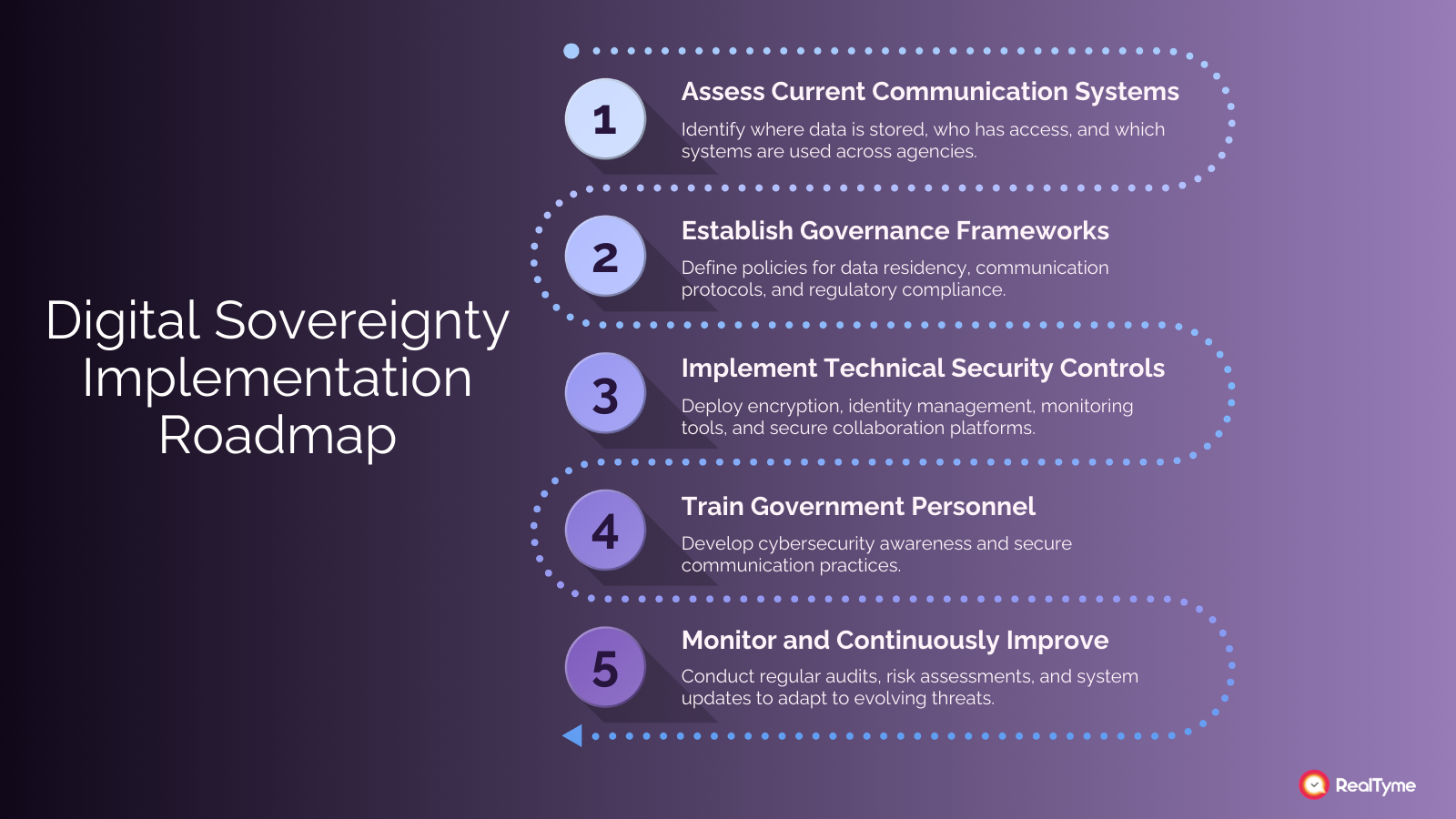
Governments can embed digital sovereignty in their communication systems through a combination of technical safeguards, governance frameworks, secure operational workflows, and future-ready technologies.
Here are practical steps to embed digital sovereignty into government communications, creating resilient, trusted systems:
1. Implement Strong Technical Safeguards
End-to-End Encryption: All messages, emails, and document exchanges should be encrypted to prevent unauthorized access. Beyond protecting sensitive information, encryption also helps maintain public trust, especially when handling citizen data or inter-agency communications. For example, governments handling health records or emergency alerts rely on encryption not just to comply with regulations but to ensure the integrity of mission-critical information.
Identity and Access Management: Role-based permissions, multifactor authentication, and continuous verification—core principles of zero trust—ensure that only authorized personnel can access specific information. Implementing these measures prevents insider threats and reduces the risk of credential compromise. A practical step is to periodically review access rights and remove privileges that are no longer necessary, which helps prevent “permission creep” that could expose sensitive communications.
Auditable Logging: Keeping detailed logs of communication activities is essential for accountability, regulatory compliance, and incident investigation. Logs provide an auditable trail that can demonstrate adherence to governance standards, uncover anomalies, and support risk management decisions. Agencies can enhance effectiveness by using automated monitoring tools that flag unusual patterns or access behaviors in real time.
2. Align Organizational Policies and Governance
Compliance Frameworks: Digital sovereignty requires alignment with national and international standards, such as NIST, ISO 27001, and GDPR. Integrating these frameworks into daily workflows ensures that communication practices are not only secure but also legally compliant. Agencies can establish clear policies for data retention, sharing, and transfer, so that all employees understand what is required in day-to-day operations.
Risk Management and Auditing: Governments should adopt a proactive risk management approach, regularly assessing communication systems for vulnerabilities and updating policies in response to emerging threats. For example, conducting tabletop exercises or simulated phishing attacks can reveal weaknesses in workflows and prepare teams for real-world scenarios.
Leadership Alignment: Leaders set the tone for secure communication practices. By actively championing digital sovereignty, allocating resources, and reinforcing policies, leaders encourage a culture where security is treated as a strategic priority rather than a technical afterthought. Regular briefings and updates from leadership help ensure that all teams understand both the “why” and the “how” of secure communications.
3. Build a Culture of Digital Sovereignty
Employee Training: Regular training programs that include phishing simulations, scenario-based exercises, and practical guidance on secure communication practices help embed security awareness across the organization. The goal is to make secure behavior instinctive, reducing the risk of human error undermining even the best technical safeguards.
Workflow Integration: Security measures should be seamlessly integrated into standard operating procedures. For example, staff sharing sensitive inter-agency reports should automatically use encrypted channels rather than unsecured emails, ensuring that security is part of daily operations and not an afterthought. Automating approval workflows for confidential communications further embeds these safeguards into routine practices, reducing the risk of human error.
Encourage Reporting: Creating a safe environment for reporting potential issues or suspicious activity is crucial. Employees should feel confident raising concerns without fear of blame, turning the organization into a learning system where frontline insights help strengthen resilience. Implementing clear reporting channels and prompt follow-ups ensures that vulnerabilities are addressed quickly.
4. Future-Proof Communications
Zero Trust Architectures: As cyber threats evolve, continuously verifying users, devices, and data access requests helps maintain sovereignty. Zero trust is not a one-time configuration but an ongoing strategy that adapts to new vulnerabilities and ensures that every access point is scrutinized.
AI-Enhanced Threat Detection: Machine learning tools can analyze communication patterns, detect anomalies, and even predict potential breaches. Imagine AI spotting unusual download patterns in real time and alerting the team before sensitive documents are exposed—this proactive monitoring can prevent a minor issue from turning into a full-blown breach. Governments can leverage these tools across messaging systems, collaboration platforms, and cloud environments to respond faster and more effectively to unusual activity.
Quantum-Ready Encryption: Preparing for the era of quantum computing ensures that communication systems remain secure even as encryption-breaking technologies emerge. Agencies should begin evaluating quantum-resistant algorithms and planning for phased implementation to protect sensitive communications well into the future.
Secure Cloud Collaboration: While cloud platforms offer scalability and efficiency, they introduce sovereignty challenges. Selecting providers that prioritize encryption, jurisdictional control, and regulatory compliance allows agencies to harness cloud benefits without compromising sovereignty. It is also critical to define clear policies for third-party access, data residency, and audit rights.
Turning Insight into Action: Professional Training Opportunities
While understanding principles is important, embedding digital sovereignty in practice often requires structured learning and hands-on guidance. Many agencies struggle to translate strategy into secure, resilient workflows that protect sensitive communications every day.
This is where professional training becomes invaluable. Programs designed for government teams can bridge the gap between awareness and operational execution, providing hands-on guidance, real-world scenarios, and actionable frameworks.
One such opportunity is our upcoming training: “What Digital Sovereignty Really Means: Building Control, Trust, and National Autonomy in the Digital Age.”
The training is designed for policymakers, regulators, and senior public-sector leaders seeking a clear, operational understanding of digital sovereignty. Through expert-led sessions, real-world examples, and a practical gap-mapping exercise, participants will identify sovereignty risks and define a phased roadmap aligned with national priorities and institutional capacity.
Strengthening Digital Sovereignty in Government Communications
Governments today operate in a complex digital environment where communication systems must remain secure, resilient, and under sovereign control. Evaluating communication infrastructure, implementing strong technical safeguards, and fostering a culture of cybersecurity awareness are essential steps toward protecting sensitive government data and operations.
Embedding digital sovereignty requires continuous commitment, collaboration, and adaptation. By strengthening governance frameworks, securing digital workflows, and investing in professional training, government agencies can build communication systems that remain trusted, resilient, and future-ready in the face of evolving cyber threats.
Enabling Sovereign Government Communications with RealTyme
Achieving digital sovereignty in government communications requires more than policies and frameworks. It also depends on secure, trusted communication platforms that are designed with sovereignty, security, and compliance in mind.
RealTyme supports government organizations with secure, encrypted communication and collaboration solutions designed for sensitive environments. By combining end-to-end encryption, strong identity and access management, and infrastructure aligned with national security requirements, RealTyme helps public-sector institutions maintain control over their communications while ensuring operational resilience.
For governments seeking to strengthen sovereign communication workflows, solutions like RealTyme can play a key role in enabling secure collaboration, protecting sensitive information, and supporting trusted digital infrastructure.
Explore how RealTyme can support secure and sovereign government communications.
Frequently Asked Questions About Digital Sovereignty in Government Communications
What is digital sovereignty in government?
Digital sovereignty refers to a government's ability to control and protect its digital infrastructure, communications systems, and data according to national laws and regulatory frameworks.
How does digital sovereignty differ from data sovereignty?
Data sovereignty focuses specifically on where data is stored and processed, while digital sovereignty includes broader control over infrastructure, communication systems, governance, and digital technologies.
Why is digital sovereignty important for public-sector cybersecurity?
Digital sovereignty ensures that sensitive government communications remain secure, compliant with national regulations, and protected from external interference or unauthorized access.
How can governments improve digital sovereignty?
Governments can strengthen digital sovereignty by implementing encryption, zero trust architectures, secure cloud infrastructure, strong governance frameworks, and cybersecurity training for staff.
What are examples of digital sovereignty in practice?
Examples of digital sovereignty include government-controlled cloud infrastructure, national data residency requirements, encrypted inter-agency communication platforms, and policies that ensure sensitive public-sector data remains within national jurisdiction.




.svg)
.svg)

.svg)
.svg)
