How Microsoft Exposed Dutch Regulators to the US Government — and What It Means for EU Data Sovereignty

The Promise That Isn't Worth the Paper It's Written On
"Don't worry — your data stays on EU servers."
If you've heard this from a US cloud provider, you've heard a promise that may be legally meaningless.
In the Netherlands, it emerged that Microsoft handed personal data of EU civil servants to the US House of Representatives — including names, emails, meeting minutes, and invitations. Not because of a cyberattack. Not because of a GDPR violation. Because of a US law called the CLOUD Act — and because Microsoft, like every American tech company, has no choice but to comply with it.
The victims included staff from the Authority for Consumers and Markets (ACM) and the Dutch Data Protection Authority (AP) — the very bodies tasked with enforcing Europe's Digital Services Act.
Let that sink in: the data of the regulators enforcing European law was shipped to a foreign parliament.
Dutch State Secretary Willemijn Aerdts confronted the US Ambassador directly: “If you have a problem, you fight it out with us or, if necessary, in Europe — but not against the backs of civil servants.”
What Is the CLOUD Act — and Why Should EU Organizations Care?
The Clarifying Lawful Overseas Use of Data (CLOUD) Act, signed into US law in 2018, compels American technology companies to hand over data stored on their servers to US law enforcement or government authorities — regardless of where in the world that data physically sits.
This means:
- Microsoft Azure EU data centers — subject to the CLOUD Act.
- Google Cloud European regions — subject to the CLOUD Act.
- Amazon Web Services Frankfurt — subject to the CLOUD Act.
If the company is incorporated in the United States, US law applies to the data it holds. Full stop.
Frequently Asked Question: Does GDPR Protect Against the CLOUD Act?
This is one of the most searched questions on EU data compliance — and the honest answer is: not reliably.
GDPR restricts how European organizations can transfer data outside the EU, but it cannot override a US federal law compelling an American company to produce data. The two legal frameworks are in direct conflict, and in practice, US authorities have compelled data disclosure from US companies operating in Europe without EU regulators having effective recourse.
Data Residency vs. Data Sovereignty: Understanding the Difference
These two terms are often used interchangeably. They are not the same thing.
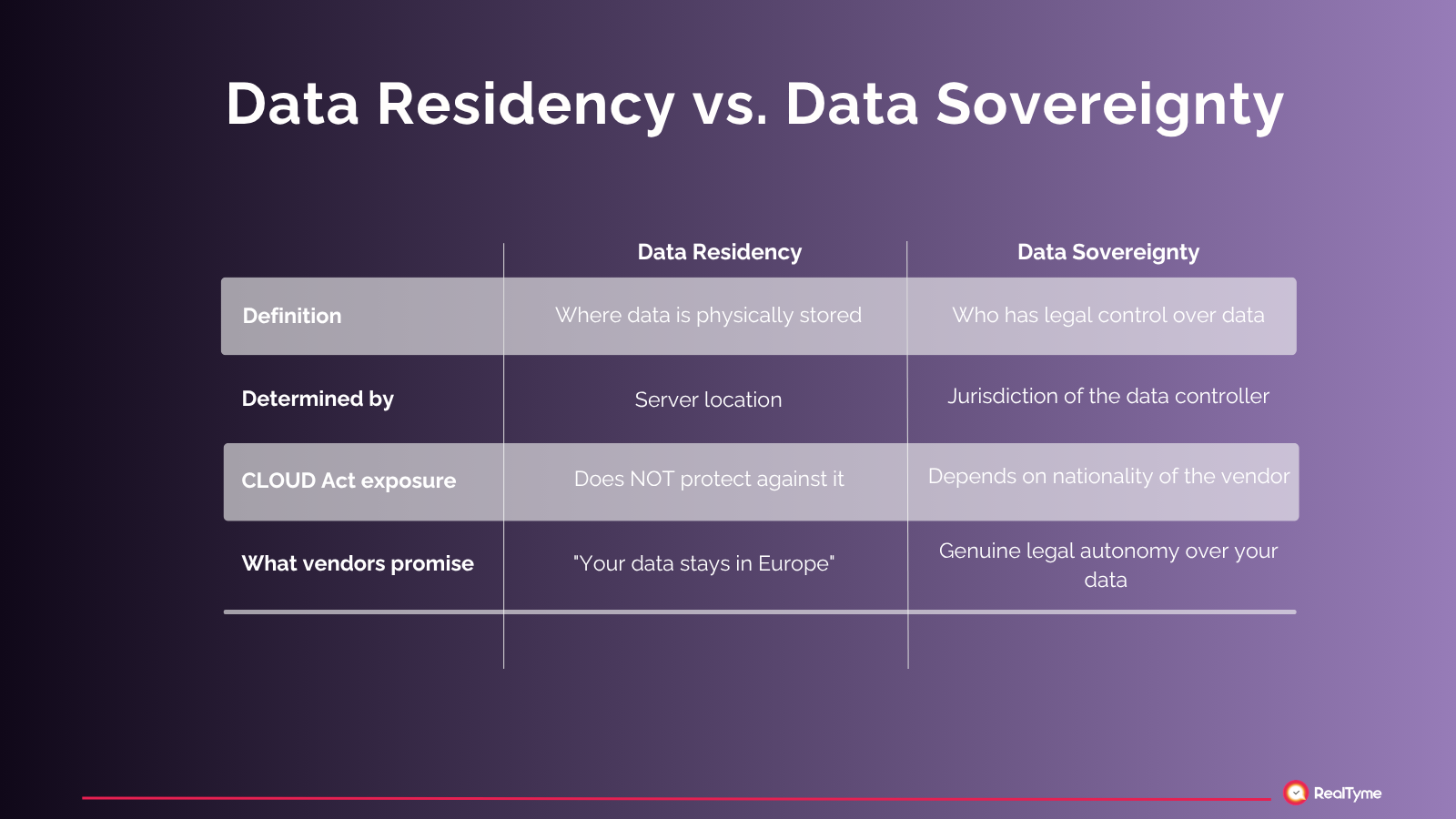
Data residency is a geographic fact. Data sovereignty is a legal and political reality.
A Dutch hospital storing patient records on a Microsoft Azure server in Amsterdam has data residency in the Netherlands. But because Microsoft is a US company, it does not have data sovereignty — US authorities can legally compel Microsoft to produce those records.
Who Is Most at Risk?
The CLOUD Act exposure isn't theoretical. European organizations with the highest risk profile include:
Public sector and government bodies — as the Microsoft case demonstrated, civil servants' communications and personal data can be exposed to foreign legislative scrutiny.
Healthcare organizations — patient records, clinical trial data, and diagnostic information held with US cloud providers carry legal exposure beyond GDPR.
Financial institutions — trading data, client records, and internal communications are all potentially accessible to US authorities through the CLOUD Act.
Critical infrastructure operators — energy, telecoms, and transport organizations whose operational data sits with US vendors face national security implications.
Any organization processing sensitive personal data — HR records, legal correspondence, M&A communications, strategic plans.
What Does Real Data Sovereignty Look Like?
True digital sovereignty means that no foreign government, through legal compulsion, can access your data without your knowledge and consent — and without going through the judicial processes of your own jurisdiction.
Achieving this requires going beyond server location. Here is what genuine sovereignty demands:
1. European Ownership of the Vendor
The data controller and processor must not be subject to US law. This means choosing vendors incorporated and headquartered in Europe — not US companies with European subsidiaries.
2. Open-Source Infrastructure
Proprietary software from US vendors creates dependency. Open-source infrastructure — where code is auditable, and no single vendor controls the stack — reduces structural exposure.
3. No US Parent Company
A European subsidiary of a US company is still subject to the CLOUD Act through the parent. Verify the full corporate ownership structure of any cloud vendor before trusting them with sensitive data.
4. Legal Agreements That Match Technical Reality
Data Processing Agreements (DPAs) and Standard Contractual Clauses (SCCs) are necessary but not sufficient. Your legal protections are only as strong as the vendor's ability to actually comply with them — which a US company receiving a CLOUD Act order cannot.
For a deeper look, read our guide on how to embed digital sovereignty in government communications.
The Right Questions to Ask Your Cloud Vendor
Before signing any contract involving sensitive EU data, ask:
1. Where is your company incorporated? (Not just your European entity — the ultimate parent.)
2. Have you ever received a CLOUD Act request? (And if so, how did you respond?)
3. Can you guarantee that no US entity in your corporate structure can be compelled to produce our data?
4. Is your infrastructure auditable under EU law?
5. What would happen to our data if your company was acquired by a US entity?
If a vendor cannot answer questions 1–3 with complete transparency, that is your answer.
The Broader Lesson: Dependency Is the Risk
The Microsoft case is not fundamentally about one company's wrongdoing. Microsoft may have had no legal choice. The CLOUD Act compelled them.
The lesson is about structural dependency on Big Tech — and the risk that comes with building critical European infrastructure on top of platforms governed by foreign law.
Notably, the US government views the Digital Services Act as a form of censorship, making the data request not just a legal technicality, but a politically motivated one.
This is why EU digital sovereignty is not a compliance checkbox. It is a strategic question about who controls your organization's most sensitive information — and under what legal framework.
The reassuring promise that "your data stays on EU servers" turns out to be worth nothing the moment a US federal subpoena arrives.
Key Takeaways
- Data residency ≠ data sovereignty. Where servers are located does not determine who can legally access the data they hold.
- The US CLOUD Act compels American tech companies to produce data held anywhere in the world, including Europe.
- GDPR does not override the CLOUD Act — the two frameworks are in conflict, and US authorities have the practical upper hand.
- True sovereignty requires European-owned vendors, open-source infrastructure, and legal structures that match technical reality.
- The risk is not hypothetical — EU civil servants, regulators, and government staff have already been affected.
How RealTyme Delivers True Data Sovereignty
Most secure communication tools are built on top of US infrastructure — which means they inherit the CLOUD Act problem by default. RealTyme was built differently, from the ground up.
RealTyme is a Swiss-based secure communications platform designed specifically for governments, defense agencies, critical infrastructure operators, and enterprises that cannot afford to compromise on sovereignty.
Here is what sets it apart:
No CLOUD Act exposure — RealTyme has no US parent company, no US infrastructure, and no legal obligation to comply with US government data requests. What happens on RealTyme stays under EU and Swiss jurisdiction.
End-to-end encryption by default — All voice, video, messages, and file transfers are encrypted with military-grade protocols. Critically, RealTyme itself cannot access your communications even if compelled by a foreign authority.
Full deployment flexibility — Organizations choose where their data lives: on-premise, private cloud, or a sovereign cloud environment within their own region. This is data residency and sovereignty working together, not just one or the other.
Zero data mining policy — RealTyme operates under a strict No AI, No Data Mining, No Third-Party Resell policy. Your data is used solely for your benefit.
NIS2 and GDPR alignment — Purpose-built to support compliance with the EU's cybersecurity and data protection frameworks, not just as an afterthought but as a foundational design principle.
Open, auditable architecture — Security posture is transparent and independently verifiable — so you don't have to take anyone's word for it.
For EU organizations asking the right questions about their cloud vendors, RealTyme answers every one of them.
Ready to close the sovereignty gap in your organization's communications? Request a RealTyme sovereignty audit to see exactly where your current setup falls short — and what real protection looks like.
Frequently Asked Questions
Is the CLOUD Act legal under EU law?
The CLOUD Act is legal under US law. Its conflict with GDPR and EU data protection frameworks is an ongoing legal and diplomatic dispute. The EU has not yet found an effective mechanism to block CLOUD Act disclosures by US vendors.
Does using a VPN or encryption protect against the CLOUD Act?
Encryption helps, but if the vendor holds the encryption keys — as most SaaS providers do — they can be compelled to produce both the data and the keys.
Are there EU equivalents to the CLOUD Act?
Several EU member states have data access laws for law enforcement, but none with the same extraterritorial reach as the CLOUD Act. The EU's e-Evidence Regulation addresses cross-border law enforcement data requests within the EU.
What is the EU doing about this?
The European Commission has pushed for digital sovereignty through initiatives like Gaia-X (a European cloud infrastructure project) and the European Data Act. Progress has been slower than many advocates would like.
The Netherlands has already taken its first concrete step, reaching a deal with a European cloud company to reduce dependency on US providers — a sign that policy is slowly catching up with reality.
Should we move everything off US cloud providers immediately?
A phased approach based on data sensitivity is pragmatic. Start by identifying which data carries the highest risk — personal data of staff and customers, legally privileged communications, strategic plans — and prioritize moving those workloads to European-sovereign infrastructure first.




.svg)
.svg)

.svg)
.svg)
