Is WhatsApp Really Private? The Lawsuit That Changed Messaging Privacy

Every day, billions of people send messages they assume are private. But a recent class action lawsuit against Meta and WhatsApp has raised serious questions about whether end-to-end encryption is enough — and who can actually access your conversations. Here's what the data, the lawsuit, and the experts reveal.
Key Terms: What These Privacy Concepts Actually Mean
End-to-End Encryption (E2EE): A method of securing messages so that only the sender and recipient can read them. The message is encrypted on the sender's device and can only be decrypted by the intended recipient. No third party — including the platform provider — should be able to read it in transit.
Metadata: Data about your communication rather than its content. This includes who you message, how often, at what times, and from where. Metadata is often not protected by E2EE and can reveal significant information about behavior and relationships.
Zero-Trust Architecture: A security model where no user, device, or system is automatically trusted — every interaction must be verified. This eliminates the risk of insider access.
End-to-End Encrypted by Default: Not all apps encrypt all message types by default. Some require users to opt in, or only encrypt certain features.
The Scale of Messaging And the Risk Behind It
The scale of modern messaging is nothing short of extraordinary and it’s growing faster than ever:
- Over 2 billion people actively use major messaging platforms worldwide
- More than 100 billion messages are exchanged every single day
- Nearly 75% of internet users rely on messaging apps as their primary form of communication
These numbers highlight just how deeply embedded messaging apps are in our daily lives. From personal conversations to business negotiations, an immense volume of information is constantly being created, shared, and stored across these platforms.
But here’s the critical takeaway:
An enormous amount of sensitive data is always in motion.
And at this scale, privacy becomes a major concern.
Whenever data flows this freely and this frequently, it naturally attracts attention from advertisers, tech companies, and, in some cases, malicious actors. Even with claims of end-to-end encryption and secure communication, questions remain about how data is handled behind the scenes.
The WhatsApp Lawsuit: A Turning Point for Messaging Privacy
One of the clearest signs that concerns around messaging app privacy are becoming more serious comes from a recent legal case involving WhatsApp and its parent company, Meta.
The case “Despite Privacy Promises, Meta, Third Parties Read and Store WhatsApp Messages, Class Action Lawsuit Alleges” highlights growing scrutiny over how private messaging platforms actually handle user data.
The case specifically alleges that WhatsApp's content moderation system — which relies on users reporting messages — creates a pathway for human reviewers and contractors to access message content that is supposed to be encrypted. The complaint raises questions about how flagged messages are processed, stored, and who has visibility into them.
This matters beyond WhatsApp. It illustrates a structural tension that exists across all major messaging platforms: the need to moderate harmful content versus the promise of absolute privacy. The two goals are fundamentally in conflict, and most platforms have not been transparent about how they balance them.
For businesses handling confidential communications — legal, financial, healthcare, executive — this is not a theoretical risk. It is a documented liability.

The original lawsuit has since been joined by two further cases in 2026 — including Dawson et al. v. Meta Platforms filed in January 2026, and Shirazi et al. v. Meta Platforms filed in March 2026, which names Accenture as a third-party contractor allegedly given access to encrypted messages. Together, these cases represent a growing legal consensus that WhatsApp's privacy promises do not match its internal practices.
Organizations like the Electronic Frontier Foundation have long emphasized the importance of clear data practices and user awareness, especially as platforms scale to billions of users.
This lawsuit could become a turning point in how companies communicate their privacy practices. It shines a light on the gap between privacy promises and real-world implementation a gap that users are becoming less willing to ignore.
As of 2026, the case remains an active reminder of the gap between platform privacy promises and real-world data practices.
Why Encryption Alone Isn’t Enough
Most modern messaging platforms proudly promote end-to-end encryption (E2EE) as their strongest security feature and for good reason. Technologies like End-to-end encryption are designed to ensure that only the sender and the intended recipient can read a message, keeping it safe from hackers, network surveillance, and unauthorized interception.
On the surface, this sounds like complete privacy.
But here’s the reality: encryption alone does not automatically guarantee total privacy.
While E2EE plays a critical role in securing messages during transmission, it doesn’t cover every aspect of how messaging platforms operate. Privacy can still be compromised or at least limited depending on how the platform is designed and managed behind the scenes.
Where Privacy Gaps Can Still Exist
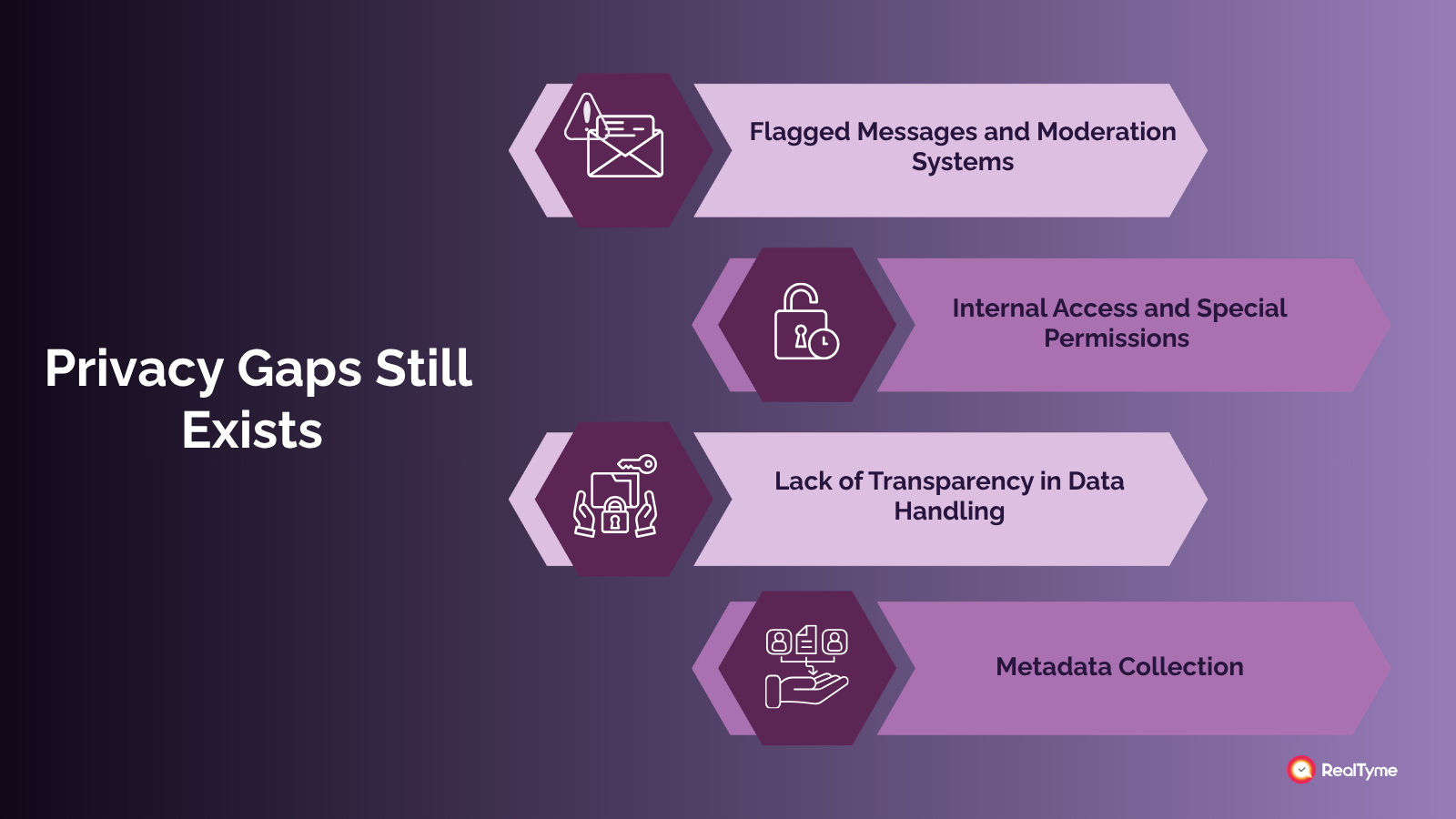
Even with strong encryption in place, there are several scenarios where user privacy may not be as absolute as it seems:
- Flagged Messages and Moderation Systems
If a message is reported or flagged, parts of it may be reviewed for safety or policy enforcement. This can sometimes involve human moderators or automated systems analyzing content.
- Internal Access and Special Permissions
Some platforms may grant internal teams or contractors limited access to certain data under specific conditions — for example, for debugging, abuse prevention, or compliance purposes.
- Lack of Transparency in Data Handling
Many users are unaware of how their data is processed beyond encryption. Without clear communication, it becomes difficult to understand what “private” actually means in practice.
- Metadata Collection
Even if message content is encrypted, platforms often still collect metadata — such as who you message, when, and how often — which can reveal a lot about user behavior.
Perhaps the most overlooked privacy risk is metadata. Even when message content is fully encrypted, platforms typically collect and retain metadata — records of who you contacted, when, how frequently, and from which location. In 2014, former NSA director Michael Hayden stated that "we kill people based on metadata," underscoring just how revealing this data can be even without access to message content. A truly private messaging platform must protect both content and metadata.
Encryption vs. True Privacy
In simple terms:
Encryption protects your messages from outsiders but not necessarily from the platform itself.
This distinction is essential for anyone concerned about messaging app security, data privacy, and digital communication risks. True privacy depends not only on encryption, but also on how companies design their systems, enforce policies, and communicate with users.
As messaging apps continue to evolve, users are starting to look beyond just “Is it encrypted?” and ask a more important question:
“How is my data actually being handled and who can access it?”
The Real Problem: Lack of User Control
Most messaging apps are built on closed systems, meaning users have no way to verify how their data is handled.
This creates a critical gap:
- You cannot see how the system works
- You cannot verify privacy claims
- You must rely entirely on trust
And in a world where data is power, trust alone is no longer enough.
RealTyme: A New Standard for Secure Communication
This is exactly the gap RealTyme was built to close. RealTyme is built on a fundamentally different principle:
Privacy should not depend on trust- it should be guaranteed by design.
What Makes RealTyme Different?
True End-to-End Encryption — Messages are encrypted on your device before they leave it. Unlike platforms where encryption can be bypassed under certain conditions, RealTyme's encryption has no administrative override.
Zero Backdoor Access — There is no internal system that allows employee or contractor access to message content, regardless of circumstance. This directly addresses the vulnerability exposed in the WhatsApp lawsuit.
Zero-Trust Architecture — Every user, device, and session is verified independently. No entity is trusted by default — not even internal systems. This eliminates the insider-access risk that affects conventional platforms.
Full Data Ownership — Your messages are never stored on RealTyme's servers in a readable format. You control retention, deletion, and access — not the platform.
Metadata Protection — RealTyme minimizes metadata collection by design, so even behavioral data about your communication patterns is not exposed.
Why Users Are Demanding Better Privacy
User behavior is shifting fast:
- 68% of users worry about how companies handle their data
- 1 in 3 people have changed apps due to privacy concerns
- Searches for secure messaging apps are rapidly increasing
This signals a major change: People are no longer choosing apps based on popularity; they are choosing based on trust and control.
The Future of Messaging: From Promises to Proof
The messaging industry is at a turning point.
The next generation of platforms will focus on:
- Verifiable privacy
- User ownership of data
- Transparent system design
RealTyme is already built for this future.
Who Needs a Truly Secure Messaging App?
Secure messaging is not just a concern for privacy enthusiasts. The following groups face real, documented risk when using conventional platforms:
Legal professionals handling privileged client communications are subject to confidentiality obligations that standard messaging apps may not support.
Healthcare providers exchanging patient information must comply with HIPAA, which requires demonstrable data protection beyond standard encryption promises.
Executives and board members discussing M&A activity, financial results, or strategic plans face material risk if those communications are accessible to third parties.
Journalists and activists operating in high-risk environments require platforms where even metadata cannot be used to identify sources or networks.
Any organization subject to GDPR or CCPA has legal obligations around how personal data in communications is stored, processed, and protected.
Frequently Asked Questions About Messaging App Privacy
Can WhatsApp read my messages?
WhatsApp uses end-to-end encryption, which means messages should only be readable by the sender and recipient. However, a series of class action lawsuits, including cases filed in 2024 and 2026, alleges that under certain conditions — such as when a message is reported — internal employees and third-party contractors may have been able to review message content. WhatsApp has not fully disclosed the details of its moderation review process.
What did the WhatsApp privacy lawsuit allege?
The lawsuit alleged that despite WhatsApp's end-to-end encryption promises, Meta and third-party contractors could access and store user messages under specific circumstances, particularly through the content moderation and reporting system.
Does end-to-end encryption guarantee complete privacy?
No. End-to-end encryption protects message content during transmission, but it does not protect metadata, does not prevent access through flagged-message moderation systems, and does not address what happens to data stored on a recipient's device or processed through third-party systems.
What is the safest messaging app in 2026?
The safest messaging apps combine true end-to-end encryption with zero-trust architecture, minimal metadata collection, no backdoor access, and full transparency about their data handling practices. RealTyme is built specifically to meet all of these criteria.
What is RealTyme?
RealTyme is a secure messaging and communication platform designed for individuals and organizations that require verified, auditable privacy. It uses end-to-end encryption with zero backdoor access, zero-trust architecture, and gives users full ownership of their data.
What is the difference between WhatsApp and RealTyme?
WhatsApp offers end-to-end encryption but has faced legal scrutiny over third-party access to messages under certain conditions. RealTyme is built with no administrative override capability, no third-party contractor access, and metadata protection — making it designed specifically for users who cannot afford privacy gaps.
Final Thoughts
Messaging apps have become central to our lives but privacy risks are becoming harder to ignore.
The WhatsApp lawsuit is not just a single case. It’s a signal of a larger issue:
Privacy promises don’t always reflect reality.
And that leads to one simple conclusion:
If you can’t verify it, you shouldn’t trust it.
RealTyme offers something different. A system where privacy is not assumed but guaranteed.
When evaluating secure messaging platforms, consider the following questions:
Can the provider access my messages under any circumstances?
Is metadata protected?
Is there independent verification of privacy claims?
RealTyme is designed to answer all three with a clear no, no, and yes.
.png)



.svg)
.svg)

.svg)
.svg)
