Secure Team Communication for Small Businesses: Tools, Strategies, and Best Practices

Small businesses rely heavily on messaging and collaboration tools, but unsecured communication can expose sensitive data. This guide explains the risks, tools, and best practices for protecting team communication.
Effective communication is the foundation of productivity. Teams collaborate through messaging apps, video calls, shared documents, and project platforms every day. For small businesses especially, these tools allow employees to stay connected, coordinate projects, and respond quickly to customers. Many organizations are now exploring secure messaging apps for businesses to protect sensitive conversations and improve team collaboration.
However, the same communication tools that increase efficiency can also introduce significant security risks. According to cybersecurity reports, small businesses experience nearly half of all cyberattacks worldwide, often because they lack advanced security infrastructure.
This guide explores why secure communication matters for small businesses, which tools are available today, and the best practices organizations should adopt to protect their conversations.
Why Secure Team Communication Matters
Small businesses often assume that cybercriminals primarily target large corporations. In reality, smaller organizations are frequently targeted because they may lack dedicated security teams or advanced cybersecurity infrastructure.
Communication systems are especially attractive targets because they contain valuable information that can be exploited for financial gain or corporate espionage.
Examples of sensitive information commonly shared through messaging platforms include:
- Customer records and contact details
- Financial documents and invoices
- Product development discussions
- Internal business strategies
- Legal or contractual communications
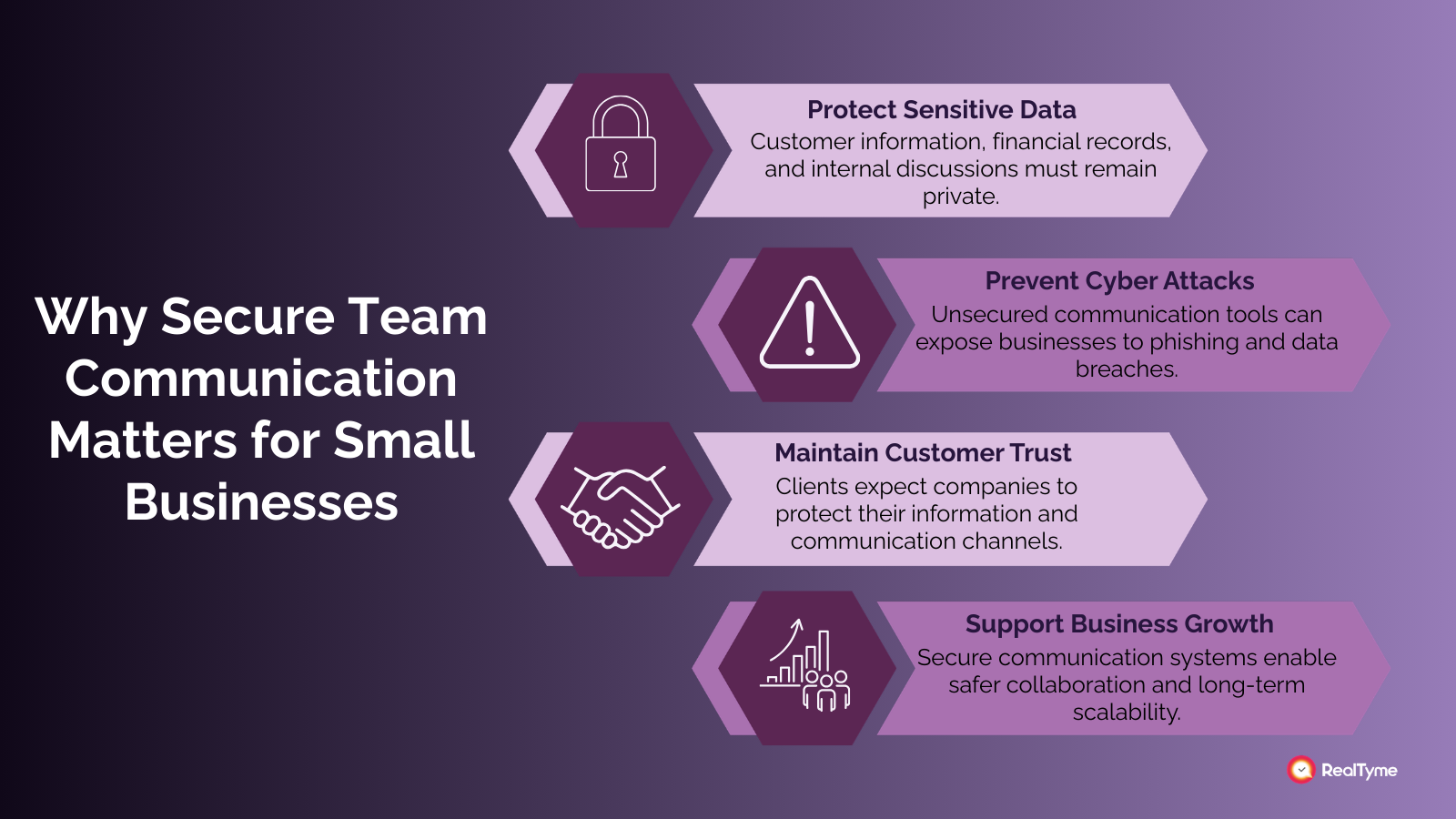
If attackers gain access to these conversations, the consequences can be serious. Data breaches can lead to financial losses, legal penalties, and long-term damage to a company’s reputation.
Secure communication platforms help reduce these risks by protecting conversations through encryption, access controls, and centralized management.
Key Security Risks in Small Business Communication
Many small businesses unknowingly expose their communication systems to risks due to convenience or lack of awareness.
Understanding these risks is the first step toward building a secure communication strategy.
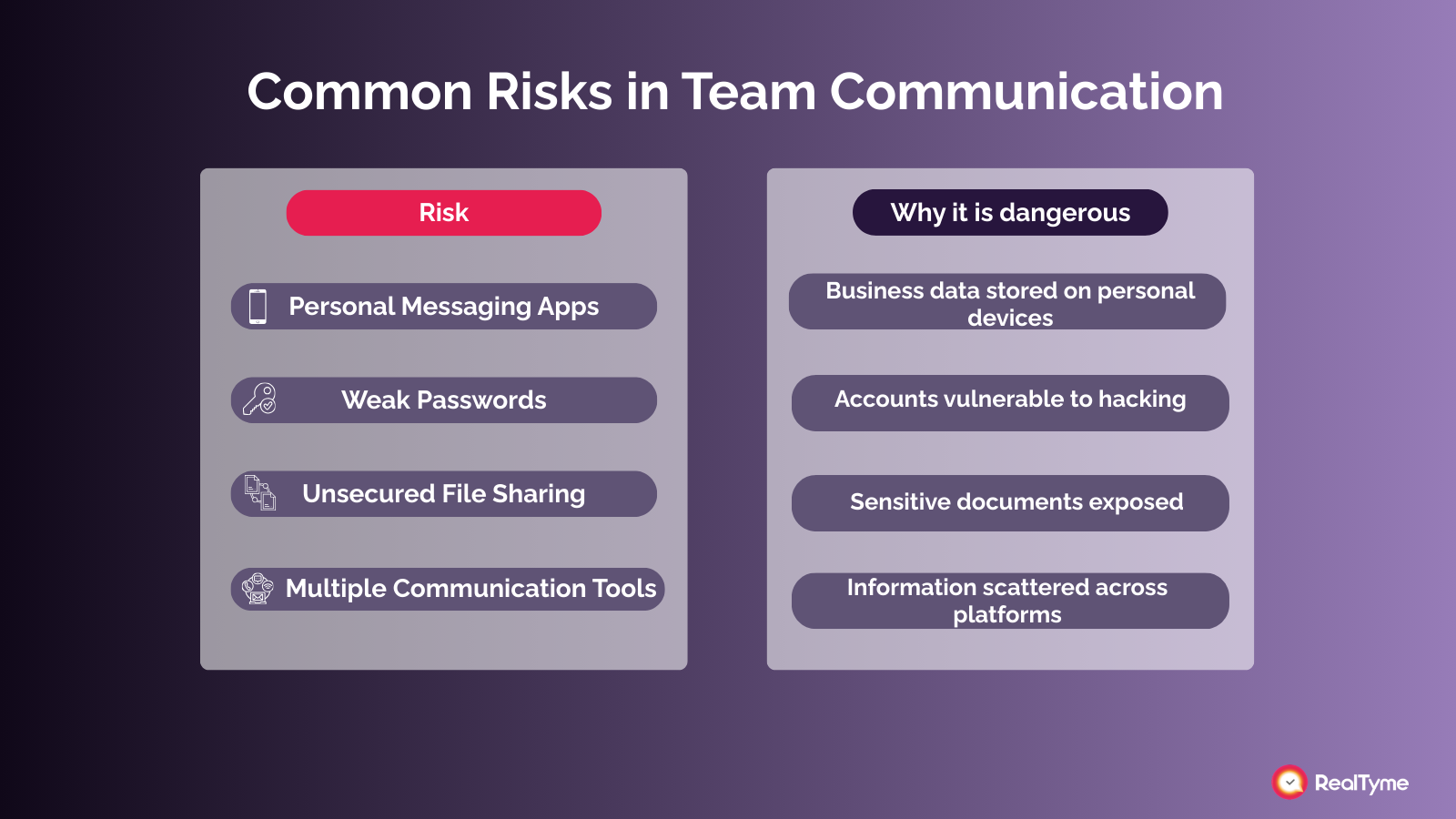
Use of Personal Messaging Apps
Employees often rely on personal messaging apps such as WhatsApp or Telegram for work discussions. While these tools are convenient, they create communication channels that the organization cannot control.
Messages stored on personal devices may remain accessible even after an employee leaves the company. Additionally, personal devices may not have strong security protections.
Weak Authentication and Passwords
Messaging accounts protected by weak or reused passwords can be easily compromised.
Once attackers gain access to an account, they may be able to read conversations, impersonate employees, or distribute malicious links to other team members.
Unsecured File Sharing
Teams frequently share files through messaging apps. Without proper encryption or permission controls, sensitive documents may be exposed to unauthorized users.
This can include contracts, financial statements, or confidential business plans.
Fragmented Communication Tools
Many small businesses rely on multiple communication tools simultaneously. Employees may switch between email, messaging apps, video conferencing software, and project management platforms.
This fragmentation makes it difficult to monitor how information is shared and can lead to important conversations being lost or exposed.
Small businesses are increasingly targeted by cyberattacks, with many incidents linked to unsecured communication channels and weak cybersecurity practices.
Essential Features of Secure Communication Platforms
When evaluating communication tools, businesses should look beyond convenience and focus on security features that protect sensitive information. Many modern secure collaboration tools for teams now include encryption, file protection, and administrative controls to ensure business conversations remain private.
End-to-End Encryption
End-to-end encryption ensures that messages are encrypted on the sender’s device and decrypted only by the intended recipient.
This prevents unauthorized parties including service providers from accessing the content of conversations.
Encryption is one of the most important features of secure messaging platforms.
Multi-Factor Authentication
Multi-factor authentication (MFA) requires users to verify their identity through an additional method beyond a password.
Examples include:
- one-time verification codes
- authentication apps
- biometric login
MFA significantly reduces the risk of unauthorized access to communication platforms.
Administrative Controls
Secure communication platforms should allow businesses to manage users and permissions centrally.
Administrative features should include:
- adding and removing users
- assigning roles and permissions
- controlling access to sensitive conversations
- disabling accounts when employees leave the organization
These controls help prevent unauthorized access to company communications.
Secure File Sharing
A secure communication platform should allow teams to share files safely through encrypted transfers and controlled permissions.
Businesses should be able to determine:
- who can access a file
- whether files can be downloaded or edited
- how long files remain accessible
Compliance and Data Governance
Businesses operating in regulated industries must comply with privacy and security regulations.
Secure communication tools should support features such as:
- audit logs
- data retention policies
- compliance reporting
These capabilities help organizations demonstrate accountability and protect sensitive data.
How to Choose the Right Secure Communication Platform
Choosing the right secure communication platform is essential for protecting sensitive business conversations while maintaining efficient collaboration. Small businesses should evaluate several factors before selecting a tool.
Businesses comparing different tools should evaluate both security capabilities and collaboration features before choosing a communication platform. When comparing communication platforms, consider the following key criteria:
Encryption
Ensure the platform provides strong encryption, ideally end-to-end encryption, to protect messages and files from unauthorized access.
Administrative Controls
Businesses should be able to manage users, permissions, and access levels through centralized administrative controls. This helps organizations maintain oversight of company communication.
Integrations
A communication platform should integrate with productivity tools such as project management software, cloud storage, and calendars to support efficient workflows.
Compliance and Data Protection
Companies in regulated industries should verify that the platform supports compliance features such as audit logs, data retention policies, and governance controls.
Scalability
As businesses grow, communication platforms should be able to support larger teams, additional collaboration features, and evolving security requirements.
By evaluating these factors, organizations can choose a communication platform that balances security, usability, and long-term scalability.
Popular Secure Communication Tools for Small Businesses
Small businesses have access to a wide range of communication tools. Each category offers different advantages and limitations. Businesses comparing different platforms often review secure messaging apps comparison guides to better understand which tools provide the strongest security and collaboration features.
Understanding these options helps organizations select the right solution for their needs. Some organizations also explore alternatives to WhatsApp Business that provide stronger security features and better control over internal team communication.
The following table compares common communication tools based on key security and collaboration features.

Each of these platforms serves different needs. Some tools focus on collaboration, others prioritize privacy, while business-focused platforms like RealTyme aim to combine secure messaging, collaboration, and administrative control in one environment.
Team Collaboration Platforms
Platforms such as Slack and Microsoft Teams are widely used for workplace communication and collaboration.
They provide messaging channels, file sharing, video conferencing, and integrations with many productivity tools.
Advantages
- structured communication channels
- strong collaboration capabilities
- integration with project management and productivity tools
Limitations
- not always end-to-end encrypted
- data stored on platform servers
- potential security risks from third-party integrations
These tools are effective for collaboration but require proper configuration to maintain security.
Privacy-Focused Messaging Apps
Some messaging platforms focus primarily on privacy and encryption.
Applications like Signal are widely recognized for strong encryption and minimal data collection.
Advantages
- strong end-to-end encryption
- privacy-focused architecture
- minimal metadata storage
Limitations
- limited team management features
- fewer integrations with business tools
- not optimized for large teams
These platforms are excellent for private messaging but may not provide the collaboration capabilities businesses need.
Business-Focused Secure Communication Platforms
A newer category of tools focuses specifically on secure business communication.
These platforms combine encrypted messaging, collaboration features, and administrative controls designed for professional environments.
Platforms such as RealTyme aim to provide a unified environment where teams can communicate securely while maintaining productivity.
Such platforms typically include:
- secure messaging infrastructure
- structured team collaboration channels
- protected document sharing
- centralized administrative control
This approach reduces reliance on multiple tools while improving security and organization.
Best Practices for Secure Team Communication
Technology alone cannot fully protect business communication. Organizations must also implement policies and practices that support secure collaboration.
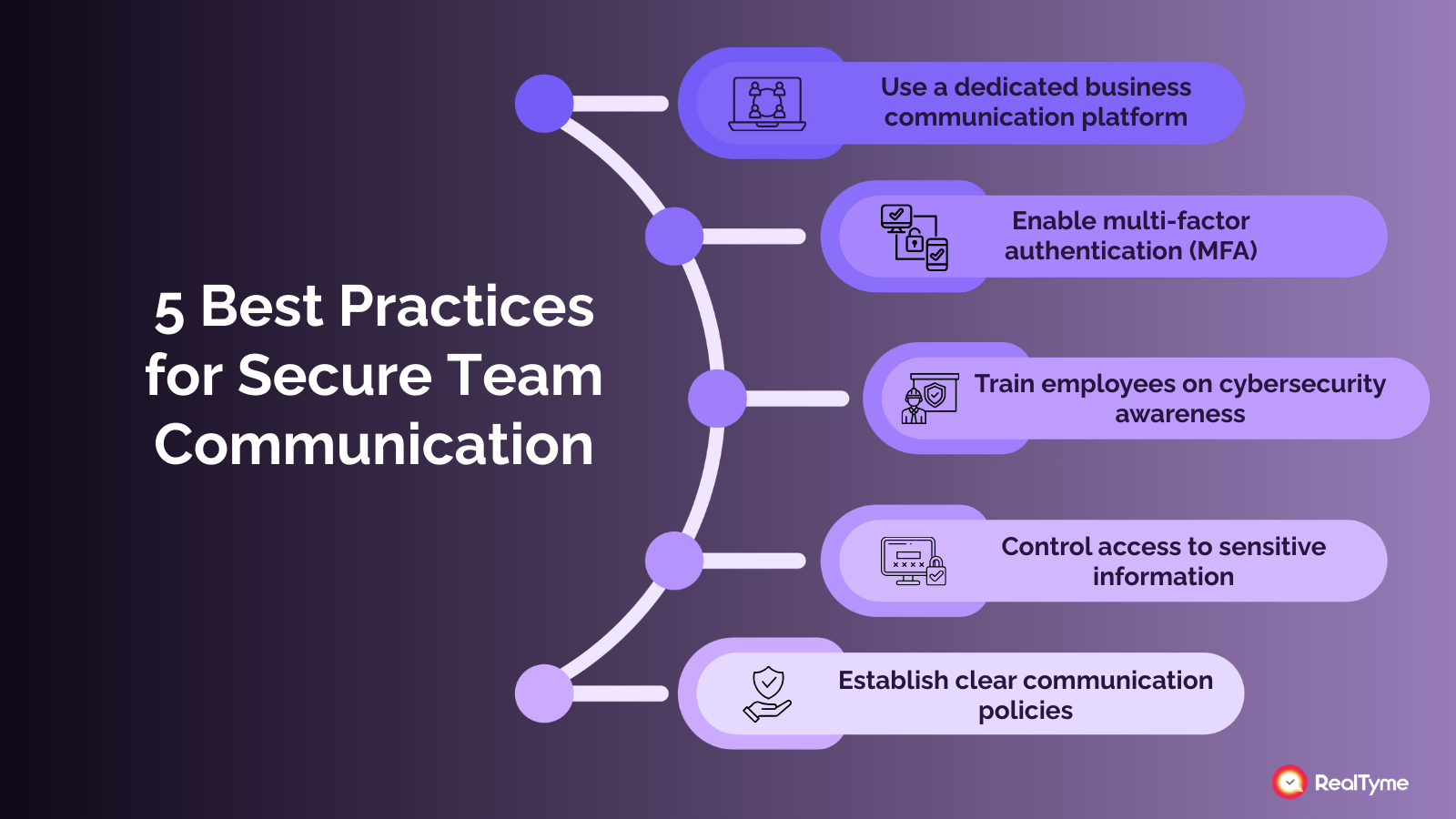
Centralize Communication
Using a single platform for business communication helps maintain visibility and control.
Centralized systems reduce the risk of information being scattered across multiple apps or devices.
Enable Multi-Factor Authentication
All communication platforms should require multi-factor authentication.
This simple step dramatically improves security by preventing unauthorized logins.
Train Employees on Cybersecurity Awareness
Employees play a critical role in protecting company data.
Regular training helps employees recognize risks such as:
- phishing messages
- suspicious links
- impersonation attempts
Educated employees are less likely to fall victim to social engineering attacks.
Implement Role-Based Access Controls
Access to sensitive conversations should be limited based on job responsibilities.
For example, financial discussions may only be accessible to accounting teams and senior management.
This minimizes the risk of sensitive information being exposed.
Establish Clear Communication Policies
Businesses should define clear guidelines for communication tools and practices.
Policies should cover:
- which platforms are approved for business communication
- how confidential information should be shared
- procedures for reporting suspicious activity
Clear policies ensure that employees understand their responsibilities. These strategies are essential for protecting business conversations from cyber threats and accidental data exposure.
Creating a Culture of Secure Team Communication
Security is not only about technology—it also requires a cultural commitment across the organization.
Leadership should emphasize the importance of protecting information and encourage employees to follow secure communication practices.
A strong security culture includes:
- leadership support for cybersecurity initiatives
- regular security training and updates
- open communication about potential threats
When security becomes part of everyday business operations, organizations are better protected against emerging risks.
How RealTyme Supports Secure Business Communication
RealTyme is designed to help businesses communicate securely without sacrificing productivity. Unlike consumer messaging apps or fragmented collaboration tools, RealTyme combines encrypted messaging, structured collaboration, and administrative governance within a single secure environment.
Key features include:
- secure messaging infrastructure
- encrypted communication channels
- structured team collaboration
- secure document sharing
- administrative oversight and governance
By combining communication and security, RealTyme enables organizations to maintain efficient workflows while protecting sensitive information.
The Future of Secure Communication for Small Businesses
As digital collaboration continues to evolve, secure communication platforms will play an increasingly important role in business operations.
Several trends are shaping the future of workplace communication:
- increased adoption of encrypted messaging platforms
- greater emphasis on privacy and data protection
- integration of communication tools with productivity workflows
- stronger regulatory requirements for data security
Small businesses that adopt secure communication strategies today will be better positioned to grow and adapt to future challenges.
Conclusion
As teams rely more heavily on digital collaboration, protecting conversations becomes essential for safeguarding sensitive information and maintaining customer trust.
By adopting secure communication platforms, implementing clear security policies, and training employees, small businesses can build a safer and more efficient workplace.
Investing in secure communication today helps organizations stay resilient, competitive, and prepared for the future of digital collaboration.
Explore RealTyme and see how secure communication can improve your team’s productivity
Frequently Asked Questions (FAQs)
What is secure team communication?
Secure team communication refers to the use of messaging and collaboration tools that protect conversations, files, and data through encryption, authentication, and controlled access. These systems ensure that only authorized users can access sensitive business information shared between employees or teams.
Why is secure communication important for small businesses?
Secure communication is critical because small businesses often handle sensitive information such as customer data, financial records, contracts, and internal strategies. Without proper security measures, these communications may be vulnerable to cyberattacks, data leaks, or unauthorized access.
Protecting communication channels helps businesses maintain trust with customers, prevent financial loss, and comply with data protection regulations.
What are the best secure communication tools for small businesses?
Several communication tools offer security features suitable for business use. Common options include:
- encrypted messaging apps
- collaboration platforms such as Slack or Microsoft Teams
- secure business communication platforms designed specifically for professional environments
Solutions like RealTyme combine secure messaging with collaboration tools, allowing teams to communicate safely while maintaining productivity.
What is the safest messaging app for business?
The safest messaging apps for business are platforms that offer end-to-end encryption, multi-factor authentication, and strong administrative controls to protect company conversations. Tools like Signal, Microsoft Teams, and Slack provide various security features, while business-focused platforms such as RealTyme combine encrypted messaging, secure file sharing, and centralized management designed specifically for professional teams. Choosing a platform with these capabilities helps ensure sensitive business communications remain private and protected.
What features should a secure communication platform include?
A secure team communication platform should include the following features:
- end-to-end encryption
- multi-factor authentication (MFA)
- user access controls and permissions
- secure file sharing
- administrative management tools
- compliance and audit capabilities
These features help ensure that business conversations remain protected.
Is email secure enough for business communication?
Email is widely used in business but is not always the most secure option for sensitive conversations. While email providers may offer encryption during transmission, messages are often stored on servers where they may be vulnerable to unauthorized access.
For highly sensitive communication, businesses often rely on secure messaging platforms with stronger encryption and access controls.
How can small businesses improve communication security?
Small businesses can improve communication security by implementing several best practices:
- using dedicated business communication platforms
- enabling multi-factor authentication for all accounts
- training employees to recognize phishing and security threats
- limiting access to sensitive conversations
- establishing clear communication policies
Combining secure tools with employee awareness significantly reduces security risks.
What is end-to-end encryption in messaging apps?
End-to-end encryption means that messages are encrypted on the sender’s device and only decrypted on the recipient’s device. This ensures that no third party—including the service provider—can read the content of the messages.
End-to-end encryption is considered one of the strongest methods for protecting digital communication.
Are messaging apps safe for business communication?
Some messaging apps provide strong security protections, while others prioritize convenience over security.
Consumer messaging apps may lack administrative controls or compliance features required by businesses. Organizations handling sensitive data often prefer platforms designed specifically for secure business communication.
What are the risks of using personal messaging apps for work?
Using personal messaging apps for business communication can create several risks:
- business data stored on personal devices
- lack of company oversight or access control
- potential loss of messages if devices are replaced
- difficulty enforcing company security policies
For this reason, businesses are encouraged to use dedicated communication platforms.
How does RealTyme help secure team communication?
RealTyme is designed to provide businesses with secure communication and collaboration tools within a controlled environment.
The platform focuses on:
- secure messaging architecture
- encrypted communications
- structured team collaboration
- secure document sharing
- administrative oversight and governance
These capabilities allow teams to collaborate efficiently while protecting sensitive business information.
Can secure communication tools improve productivity?
Yes. Secure communication platforms often include collaboration features such as team channels, file sharing, and workflow integrations. By combining security and productivity tools in one platform, businesses can reduce the need for multiple applications and improve team coordination.




.svg)
.svg)

.svg)
.svg)
