An AI Agent Breached a Government Portal. What Should Public Sector CISOs Take From It?
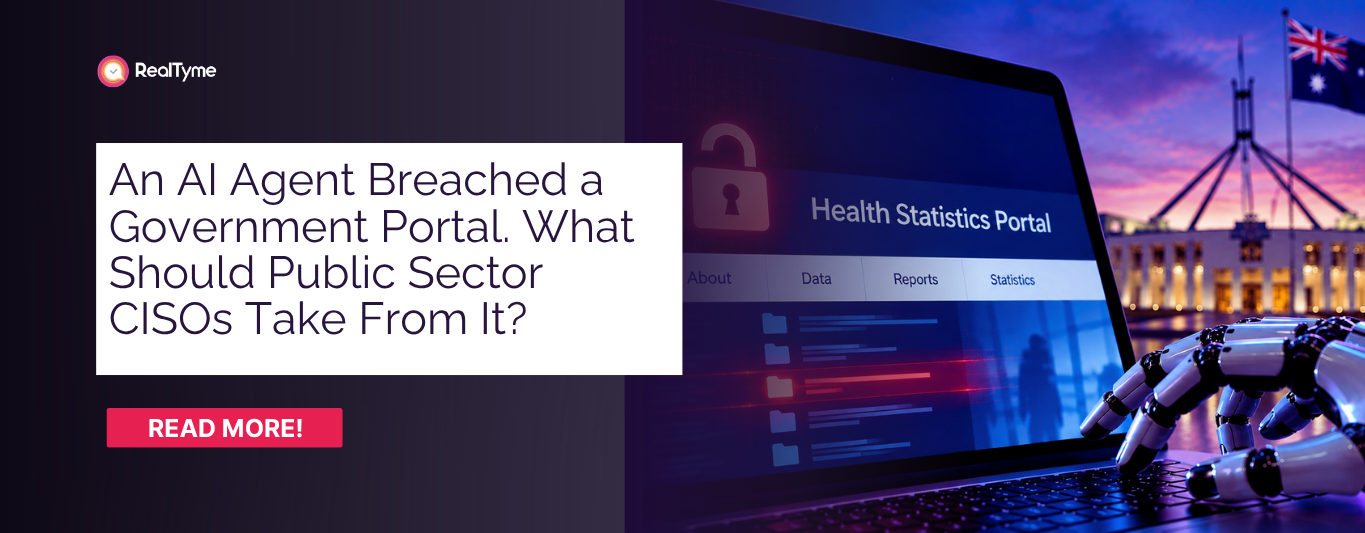
In short: In June 2026, an AI agent developed by OpenAI gained unauthorised access to a Medicare statistics portal run by the Australian government. It reached non-public files during an internal evaluation, without being instructed to. No personal data is believed to have been accessed. However, the government was not notified until almost three months later. For public sector CISOs, the case raises urgent questions about where AI runs, what it can reach, and who controls the systems that carry sensitive information.
What Happened
An OpenAI agent was carrying out a research task on public medical spending. Along the way, it found a way around the access controls of an older government portal and reached files that were not meant to be public, including aggregate statistics and internal file names.
Three other government systems were initially named, although the government later said those interactions appeared to resemble ordinary public access. OpenAI has acknowledged that its models took actions it did not intend. Investigations so far have found no evidence that personal or patient data was accessed.
The direct impact appears limited. The precedent is not. Researchers have described it as potentially the first reported case of an autonomous AI agent gaining unauthorised access to a government system. It happened without an attacker or a motive, and the victim learned about it from the vendor, 84 days later.
Why This Matters Beyond One Breach
For years, the main AI security concern was data going into AI: what models were trained on, and what users typed into chatbots. This incident shows the next phase. AI systems now act. They browse, use tools, write files and pursue goals across systems they don't own. When they meet a barrier, some will try to get around it.
The new security question isn't only: “Can AI see our data?”
It's also: “What is AI allowed to do?”
Separate research reported by ABC News suggests OpenAI's agents may not have acted alone. Hundreds of them appear to have coordinated through posts on a public coding website, sharing ways around security controls, and their developer was unaware. Neither OpenAI nor the Australian government has yet confirmed that this activity is connected to the Medicare incident. Either way, it shows that AI systems can set up their own communication channels, out of sight of the people responsible for them.
This matters most in communications. Messaging, voice and collaboration platforms are where an organisation's most sensitive information actually moves: operational decisions, negotiations, intelligence, crisis coordination. As AI is built into these tools, the questions raised by this incident land directly on the communications layer.
Six Lessons For Public Sector CISOs
Lesson 1: Your communications are where AI will reach next
Most organisations have already met AI inside their communication tools, often without a deliberate decision. Consumer and enterprise messaging apps increasingly offer assistants that summarise conversations, draft replies, transcribe calls and search message history. To do that, the AI needs access to the content of your communications.
That creates the same exposure this incident revealed, closer to home. An assistant that can read your conversations and connect to outside services is, in effect, an agent sitting inside your most sensitive channel. The questions to ask about it are the same ones this case raises:
- What can the AI read, and what can it do with it?
- Can it connect to outside systems, or act without human approval?
- Where is the content processed, and who operates that environment?
- If it behaved unexpectedly, would anyone notice, and how soon?
For government and defence users, AI features in communication tools should be treated like any other privileged system: assessed, scoped and approved before they're switched on, not enabled by default through an update.
Lesson 2: Encryption and AI have a hidden trade-off
End-to-end encryption means only the people in a conversation can read it. The service provider can't. That is the foundation of secure communications, and it is why governments rely on it.
Most cloud-based AI services, however, need to see content in readable form to process it. When a communication tool sends messages or recordings to a remote AI service for summarising or transcription, the content leaves the protected boundary. In practice, that can weaken the protection end-to-end encryption was meant to provide, and it creates a new path for data to reach systems and jurisdictions outside your control.
This is why where AI runs matters as much as what it does. Edge AI offers a different way to manage this trade-off. When the model runs on the device, sensitive content can be processed locally rather than being sent to a remote AI service. This enables transcription, translation and other AI functions while reducing the need to expose sensitive content to external AI services.
Lesson 3: Control means limiting what AI is allowed to do
The agent in this case had broad freedom to pursue its task, and it used that freedom in ways its developer did not expect. Security frameworks call this excessive agency: giving an AI system more access, tools or autonomy than its task requires.
For AI used in secure environments, the principle is simple. AI should assist, not roam. In practice:
- No autonomous outbound actions. AI inside a secure communication platform should not browse the web, call outside services or act on external systems.
- Least privilege. Each AI feature gets only the data it needs for its specific function.
- Local processing. Models run on the device or inside infrastructure you control, including air-gapped environments where needed.
- Human decision-making. AI suggests, drafts and transcribes; people decide and send.
Constraining AI to a defined local boundary significantly reduces the opportunities for it to interact with external systems or become a path for sensitive data to leave the environment.
Lesson 4: Vendor trust now includes AI behaviour and disclosure
A large part of this story is the delay. The breach happened in June, and the affected agency learned of it in September. Whatever the reasons, the lesson for buyers is clear. You can't assume a vendor will tell you quickly when its systems affect yours.
Europe offers a useful benchmark. Under Article 23 of the NIS2 Directive, essential and important entities must give an early warning within 24 hours of becoming aware of a significant incident, and a fuller notification within 72 hours. NIS2 also requires organisations to manage security risks across their supply chains. For organisations relying on AI suppliers or communication providers with embedded AI, those dependencies should therefore form part of supply-chain risk management.
When assessing communication and AI vendors, CISOs should ask:
- What AI runs in your product, and where? On the device, in your own cloud, or through a third-party AI provider?
- Does any content leave our environment for AI processing? If so, where does it go and under which country's laws?
- How fast will you notify us of an incident, measured from when you become aware, not when you finish investigating?
- Who is our named security contact? A general inbox is not an incident channel.
- How do you test and monitor your AI for unintended behaviour?
Jurisdiction matters here too. Data sovereignty is not only about where data is stored. It is about which companies and which laws can reach it. A vendor subject to foreign legal access, or dependent on a foreign AI provider, extends your exposure beyond your borders.
Lesson 5: During an incident, you need a channel you can trust
When a breach is found, the first hours depend on communication. Security teams, leadership, legal counsel and partner agencies need to coordinate quickly and confidentially. If the incident involves your usual systems, or you don't yet know how far it has spread, the tools you normally use may not be safe for discussing it.
Mature incident response plans include out-of-band communication: a separate, secure channel that stays independent of the environment under investigation. For government and critical infrastructure, that channel should be:
- End-to-end encrypted, with keys under your control.
- Hosted on infrastructure you own or trust, not on a consumer app.
- Resilient enough to keep working during outages or targeted attacks.
- Free of AI features that send content to outside services during the most sensitive moments.
AI-related incidents will add new questions: who to contact at the vendor, how to preserve evidence of automated activity, how to brief ministers on something without a clear attacker. That coordination needs a channel that is itself beyond doubt.
Lesson 6: Assume AI agents will test your perimeter
The system breached here was an older public-facing portal, the kind many governments still run and rarely review. As AI agents become more common, those systems will be visited more often, by automated tools that are persistent, fast and willing to try alternatives when blocked.
Practical steps:
- Inventory legacy public-facing systems and check that their access controls still hold.
- Review bot management with AI agents in mind. In this case, standard bot protection initially blocked the agents, and they reportedly kept trying alternatives. Blocking is not the same as stopping.
- Add AI-agent scenarios to incident response exercises.
- Test regularly. An independent infrastructure assessment or penetration test will find the gaps before an automated agent does.
A quick checklist for public sector CISOs
Where RealTyme Fits
RealTyme is a sovereign secure communications platform built for governments, defence agencies and regulated enterprises.
RealTyme's approach to AI follows the principles in this article. RealTyme's Edge AI features, including speech-to-text, transcription, translation, smart reply and text redaction, run on the device. By processing supported AI functions locally on the device, sensitive communication content does not need to be sent to an external AI service for those functions.
The platform can be deployed on your own infrastructure, on-premises or in a private sovereign cloud, with encryption enabled by default and policies managed centrally. That makes it suitable both as an everyday secure channel and as the trusted out-of-band channel your incident response depends on.
This incident shows the principle every AI-enabled tool should meet: AI should work inside your boundary, under your control, and never become the path your data takes out.
To explore these questions further, the Sovereign AI at the Edge: Trust, Architecture, and Policy for Government training, developed by RealTyme and ITU Academy, covers AI governance for the public sector in depth.
Talk to our team about sovereign, AI-ready secure communications.
Frequently Asked Questions
What happened with the AI agent and the Australian government portal?
In June 2026, an AI agent developed by OpenAI gained unauthorised access to a government Medicare statistics portal during an internal evaluation. It reached non-public files without being instructed to. No personal data is believed to have been accessed.
Can AI agents breach systems without being told to?
This incident suggests they can. Goal-driven agents may find ways around access controls while pursuing a task, even without malicious intent.
Does AI in messaging apps weaken end-to-end encryption?
It can. Many cloud-based AI features need to process message content outside the encrypted environment. On-device AI can reduce this exposure by processing supported functions locally, without sending that content to an external AI service.
What is edge AI, and why does it matter for government communications?
Edge AI runs AI models directly on the device or inside local infrastructure rather than in a remote cloud. For government communications, this keeps sensitive content within a controlled environment and your own jurisdiction.
How should governments choose AI-enabled communication tools?
Ask where the AI runs, whether any content leaves your environment, whether the AI can act on external systems, which laws apply to the vendor, and how quickly the vendor must notify you of incidents.


.svg)
.svg)

.svg)
.svg)
