Top 10 Secure Alternatives to WhatsApp Business in 2026

Best Encrypted Business Messaging Apps for Enterprise Security, Compliance & Incident Response
In 2026, business messaging is about security, compliance, and operational resilience.
Organizations across finance, healthcare, government, critical infrastructure, and enterprise technology now depend on real-time messaging to coordinate teams, communicate with customers, and manage high-stakes situations. But as cyber threats grow more sophisticated and global data regulations tighten, many leaders are questioning whether WhatsApp Business is truly built for modern enterprise risk environments.
While WhatsApp Business provides end-to-end encryption and global familiarity, it was originally designed as a customer engagement extension of a consumer messaging platform rather than a fully governed enterprise communication system. For organizations handling sensitive data, regulated communications, or cybersecurity incidents, that distinction matters.
Security leaders are now seeking messaging platforms that combine encryption with governance, identity control, data sovereignty, and the ability to operate during cyber incidents.
This article compares the top secure WhatsApp Business alternatives in 2026 across end-to-end encryption, enterprise admin controls, compliance features (audit logs, eDiscovery, retention), deployment options (cloud, hybrid, on-prem, sovereign), and incident readiness. Signal and Session prioritize privacy; Wire, Element, and Mattermost support stronger governance and deployment control; Slack and Webex excel in enterprise collaboration; and RealTyme is purpose-built for secure incident communication and executive war rooms.
Why Organizations Are Moving Beyond WhatsApp Business
Enterprises are not abandoning WhatsApp Business because encryption is weak. They are moving beyond it because modern risk environments require governance, auditability, identity integration, and incident-ready communication.

1. Regulatory Pressure & Audit Expectations
Across industries, regulatory oversight is intensifying. Organizations in finance, healthcare, public sector, and critical infrastructure must comply with frameworks such as:
- GDPR (General Data Protection Regulation)
- HIPAA (Health Insurance Portability and Accountability Act)
- FINRA and SEC communication retention rules
- ISO 27001 and SOC 2 standards
- National data sovereignty laws
Modern compliance demands retention policies, audit logs, legal hold, and export controls — capabilities not native to consumer-style messaging platforms.
2. Limited Administrative and Audit Controls
Enterprise IT teams require visibility and control over internal communications. Common concerns include:
- Limited centralized user management
- Insufficient role-based access control (RBAC)
- Lack of detailed audit logs
- Restricted eDiscovery functionality
- Minimal governance over message exports and file sharing
Without enterprise-grade administrative oversight, organizations struggle to enforce communication policies or conduct internal investigations effectively.
3. Inadequate Data Residency and Sovereignty Options
Data localization has become a strategic priority. Many governments and regulated sectors require that sensitive communications be:
- Stored within specific geographic regions
- Hosted in sovereign cloud environments
- Deployed on-premise or in private infrastructure
Consumer messaging platforms typically operate in centralized global cloud environments, offering limited flexibility around data residency and sovereign hosting requirements.
4. Increased Risk of Account Compromise and Social Engineering
Cybercriminals increasingly target messaging platforms for:
- Account takeover attacks
- SIM swapping
- Phishing and impersonation
- Business email compromise (BEC)-style messaging fraud
When messaging apps lack advanced identity verification, hardware-based authentication, and conditional access controls, they become attractive entry points for attackers.
Modern secure messaging platforms integrate:
- Multi-factor authentication (MFA)
- Hardware security keys
- Enterprise identity providers (IdPs)
- Conditional access policies
This significantly reduces account compromise risk.
5. Lack of Dedicated Incident-Response Communication Channels
During a cybersecurity incident, ransomware attack, or system breach, organizations need a secure, out-of-band communication environment that remains operational even if primary systems are compromised.
Consumer messaging tools are not purpose-built for:
- Crisis coordination
- Executive war rooms
- Secure forensic collaboration
- Controlled information dissemination
Without a dedicated, hardened incident-response communication platform, organizations risk further exposure during high-pressure events.
What Makes a Secure Business Messaging Platform in 2026?
Not all encrypted messaging apps are built for enterprise risk environments. When evaluating secure alternatives to WhatsApp Business, organizations must look beyond basic chat functionality and assess platforms through a security, compliance, and operational resilience lens.
A truly secure business messaging platform combines strong encryption, enterprise governance, identity control, and crisis readiness; without sacrificing usability.
Below are the critical security and operational features decision-makers should prioritize.
1. End-to-End Encryption (E2EE)
End-to-end encryption ensures that only intended recipients can access messages, voice calls, video calls, and shared files; not even the platform provider.
Enterprise-grade encryption should also include:
- Forward secrecy
- Encrypted file storage and backups
- Protection against metadata leakage
- Cryptographic transparency or open standards
Without robust E2EE, sensitive corporate communications may be exposed to interception, insider misuse, or third-party access.
2. Enterprise Identity & Access Management (IAM)
Secure messaging must be integrated with enterprise identity infrastructure. This reduces the risk of unauthorized access and account compromise.
Look for support for:
- Single Sign-On (SSO) integration
- Multi-Factor Authentication (MFA)
- Hardware security keys (FIDO2/WebAuthn)
- Conditional access policies
- Role-Based Access Control (RBAC)
- Automated user provisioning and deprovisioning
Strong IAM controls are essential for preventing phishing attacks, insider threats, and lateral movement during cyber incidents.
3. Administrative Controls & Audit Logs
Compliance-driven organizations require full visibility into user activity and communication governance.
A secure enterprise messaging platform should provide:
- Detailed audit logs
- Channel and user-level permissions
- Legal hold capabilities
- eDiscovery and export controls
- Configurable data retention policies
These features support regulatory compliance, internal investigations, and incident forensics.
4. Data Sovereignty & Deployment Flexibility
Data residency is increasingly a regulatory and strategic requirement. Enterprises may need to ensure communications are stored within specific jurisdictions or protected under sovereign infrastructure.
Secure messaging platforms should offer:
- Regional hosting options
- Sovereign cloud environments
- On-premise deployment
- Private cloud infrastructure
- Air-gapped or isolated configurations for high-security sectors
This flexibility is critical for government agencies, defense contractors, financial institutions, and healthcare organizations.
5. Incident-Ready Communication Capabilities
During ransomware attacks, data breaches, or infrastructure failures, primary communication systems may be compromised. A secure messaging platform should provide a resilient, isolated environment for crisis coordination.
Incident-ready capabilities include:
- Executive-level “war room” channels
- Rapid onboarding during emergencies
- Controlled external collaboration
- Encrypted file exchange for forensic artifacts
Without a dedicated crisis communication layer, organizations risk operational paralysis during high-impact events.
6. Usability Under Pressure
Security must not come at the cost of usability. Complex systems often drive employees toward shadow IT or unsecured alternatives.
An effective secure messaging platform should be:
- Intuitive and fast
- Cross-platform (desktop, mobile, web)
- Easy to deploy at scale
- Designed for high adoption across technical and non-technical teams
During a cybersecurity incident or compliance audit, speed and clarity of communication are just as important as encryption strength.
Comparison Table: Secure WhatsApp Business Alternatives (2026)
The table below provides a high-level comparison of leading platforms based on governance, deployment flexibility, and incident-readiness.

Detailed Review of Secure WhatsApp Business Alternatives
As enterprises strengthen cybersecurity programs and regulatory oversight intensifies, many organizations are reassessing whether WhatsApp Business meets modern enterprise security requirements.
While WhatsApp Business provides end-to-end encryption and global accessibility, it was not originally designed as a fully governed, compliance-centric enterprise communication platform. Companies operating in finance, healthcare, government, legal services, defense, and critical infrastructure often require:
- Advanced administrative oversight
- Integrated identity and access management
- Data sovereignty and regional hosting options
- Audit-ready logging and retention controls
- Secure out-of-band communication during cyber incidents
Below is a comprehensive, in-depth review of the top secure alternatives to WhatsApp Business in 2026, including their strengths, ideal use cases, and enterprise considerations.
1. RealTyme — Secure Incident Communication Platform
RealTyme differs from traditional messaging platforms because it is purpose-built for secure incident communication rather than everyday collaboration. It is designed to provide isolated, high-assurance communication environments for executives, security teams, and response partners during cybersecurity incidents.
The platform emphasizes strict identity verification, limited integrations, and controlled retention policies to reduce exposure during crises. It enables organizations to establish secure “war room” environments that remain operational even if primary systems are compromised.
Unlike traditional messaging tools, RealTyme focuses on resilience during ransomware events, data breaches, and crisis coordination.
Ideal for: Enterprises, government agencies, and critical-infrastructure operators that require confidential, auditable, and resilient communication during high-stakes events.
2. Signal
Signal is widely considered one of the most secure messaging platforms available, built around the open-source Signal Protocol and designed with privacy as its primary objective. Messages, calls, and file transfers are encrypted by default, and the platform intentionally minimizes metadata retention. This approach has made Signal a trusted choice among journalists, activists, and cybersecurity professionals who prioritize confidentiality.
However, Signal’s privacy-first philosophy means it offers limited enterprise administration and compliance tooling. Organizations cannot easily enforce centralized policies, integrate detailed audit logging, or implement retention controls. For enterprises that require governance and regulatory alignment, Signal is often used for high-trust communication among small groups rather than as a company-wide platform.
3. Threema
Threema, headquartered in Switzerland, focuses on data minimization and user anonymity. Unlike many messaging platforms, it does not require a phone number or email address for registration, instead using randomly generated user IDs. This design reduces the amount of personal data stored within the system and aligns with European privacy expectations.
Threema Work, the enterprise version, provides centralized management features that allow organizations to control user access and device policies while maintaining strong encryption. Its emphasis on privacy and minimal data collection makes it attractive to European enterprises and organizations with strict data-protection requirements. However, its ecosystem and integrations are more limited compared to large enterprise collaboration suites.
4. Wire
Wire positions itself as an enterprise-ready secure communication platform that combines end-to-end encryption with governance and compliance features. It supports messaging, voice, and video communication and offers deployment flexibility through cloud, private cloud, and on-premise options.
For organizations operating in regulated industries, Wire provides features such as legal hold, audit capabilities, and administrative controls. Its ability to align encryption with compliance requirements makes it a strong candidate for financial services, legal firms, and healthcare organizations. While not specifically designed for incident response, it provides a more structured and governed environment than consumer messaging tools.
5. Element (Matrix Protocol)
Element operates on the decentralized Matrix protocol, allowing organizations to deploy and control their own communication servers. This architecture provides significant flexibility and sovereignty, enabling enterprises and governments to maintain full ownership of their messaging infrastructure.
Because organizations can self-host Element servers, they can implement custom security controls, integrate with internal identity systems, and ensure data remains within specific jurisdictions. This level of control makes Element particularly appealing to government agencies and defense organizations that require independence from centralized SaaS providers. However, managing a federated system can introduce operational complexity.
6. Session
Session is designed to minimize metadata exposure and remove centralized identifiers. It does not rely on phone numbers or central account servers and routes messages through a decentralized network. This architecture makes it highly resistant to surveillance and metadata collection.
While this design is advantageous for anonymity and privacy, Session offers limited enterprise governance and administrative oversight. As a result, it is typically used in high-risk environments where privacy outweighs compliance or administrative requirements.
7. Olvid
Olvid takes a unique approach by eliminating centralized directories. Users must exchange cryptographic identifiers directly, preventing attackers from enumerating user lists or scraping directories. This design reduces the risk of impersonation and reconnaissance attacks.
The platform has gained adoption within European government sectors due to its strong identity verification model. Although it provides secure messaging with strong encryption, its enterprise ecosystem and collaboration features remain narrower than large-scale enterprise platforms.
8. Mattermost
Mattermost is an open-source collaboration platform widely used in DevSecOps and government environments. It offers self-hosting and air-gapped deployment options, allowing organizations to maintain full control over their communication infrastructure.
With granular permissions, integration with internal systems, and strong administrative controls, Mattermost supports highly secure internal collaboration. It is particularly suited for technical teams and organizations that require internal hosting and integration with development workflows. However, its primary focus is collaboration rather than standalone private messaging.
9. Slack (Enterprise Grid)
Slack Enterprise Grid provides large organizations with advanced administrative controls, compliance exports, and integration with enterprise identity providers. It supports structured collaboration at scale and includes features such as audit logs and enterprise key management.
While Slack does not offer full end-to-end encryption across all services, it remains a widely adopted enterprise collaboration platform. Its strength lies in usability and integration rather than maximum cryptographic isolation, making it suitable for many corporate environments but less ideal for high-assurance incident communication.
10. Cisco Webex
Cisco Webex combines messaging, meetings, and calling within a unified enterprise platform. It integrates with enterprise identity systems and supports encrypted communication alongside compliance certifications.
Because Webex is part of a broader enterprise ecosystem, it is often selected by multinational organizations seeking a single vendor for collaboration tools. Its strength lies in integration and scalability rather than specialized incident-response capabilities.
The Strategic Balance: Security, Compliance, and Usability
When choosing a WhatsApp Business alternative, organizations should not focus on encryption alone. A strong platform must balance:
- Cryptographic protection
- Governance and auditability
- Regulatory alignment
- Infrastructure flexibility
- Crisis resilience
- User experience
Secure messaging in 2026 is not simply about private chat, but building a resilient communication layer that supports compliance, protects sensitive data, and remains operational during cyber crises.
The right choice strengthens both cybersecurity posture and organizational trust.
Secure Communication in Regulated Industries
As regulatory oversight increases and cyber threats become more targeted, secure business messaging is especially critical in highly regulated industries. Organizations operating in sensitive sectors cannot rely solely on consumer-style messaging apps. Instead, they must adopt encrypted, compliant, and governance-ready alternatives to WhatsAppBusiness that align with industry-specific risk profiles.
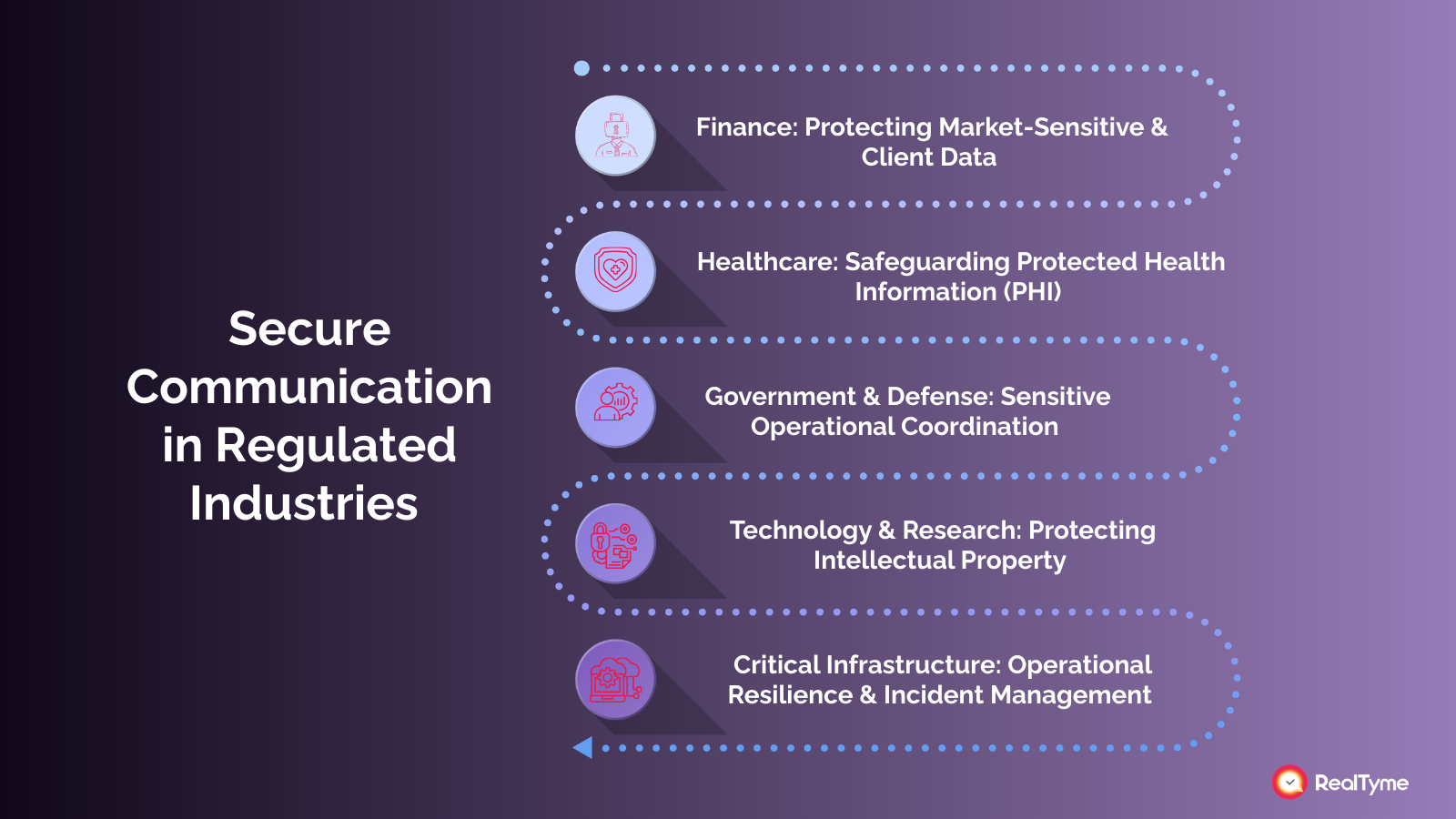
Below is how secure communication directly impacts major regulated sectors:
Finance: Protecting Market-Sensitive & Client Data
Financial institutions manage highly sensitive information, including:
- Market-moving intelligence
- Trading strategies
- Mergers and acquisitions discussions
- Client financial data
- Regulatory filings
Compliance frameworks such as FINRA, SEC regulations, MiFID II, and global banking standards require audit trails, retention policies, and communication monitoring.
Secure messaging platforms for finance must offer:
- Detailed audit logs and eDiscovery
- Configurable retention and legal hold
- Strong identity verification (MFA, SSO, hardware keys)
- Data residency controls
A communication breach in financial services can result in regulatory penalties, reputational damage, and market instability.
Healthcare: Safeguarding Protected Health Information (PHI)
Healthcare providers, insurers, and life sciences organizations handle Protected Health Information (PHI) under strict regulations such as HIPAA and GDPR.
Secure healthcare messaging solutions must ensure:
- End-to-end encryption for patient data
- Role-based access controls
- Secure file and image sharing (labs, scans, reports)
- Comprehensive audit trails
- Compliance-ready documentation
Unauthorized disclosure of PHI not only violates regulations but erodes patient trust and exposes organizations to significant fines.
Government & Defense: Sensitive Operational Coordination
Government agencies and defense organizations operate in environments where communication confidentiality is directly tied to national security.
Secure messaging platforms in this sector require:
- Sovereign or on-premise deployment options
- Controlled federation between trusted entities
- Strong identity proofing and access restrictions
- Minimal metadata exposure
- Resilience during cyber attacks
Operational coordination, emergency response, and classified discussions demand infrastructure that cannot be easily compromised or surveilled.
Technology & Research: Protecting Intellectual Property
Technology companies, startups, and research institutions depend on secure messaging to protect:
- Proprietary algorithms
- Product roadmaps
- Patent strategies
- Source code collaboration
- Strategic acquisitions
Cyber espionage and insider threats frequently target intellectual property through compromised communication channels.
Secure alternatives to WhatsApp Business allow organizations to:
- Restrict channel membership
- Monitor administrative activity
- Control integrations and exports
- Enforce Zero Trust access policies
In innovation-driven sectors, leaked conversations can eliminate competitive advantage overnight.
Critical Infrastructure: Operational Resilience & Incident Management
Energy providers, utilities, telecommunications firms, and transportation networks rely on secure messaging for real-time operational coordination.
During a cyber incident or system disruption, communication platforms must remain:
- Isolated from compromised systems
- Accessible to verified responders
- Encrypted and auditable
- Capable of secure executive-level coordination
For critical infrastructure operators, communication security directly impacts public safety, service continuity, and regulatory accountability.
Why Secure Messaging Is a Strategic Imperative
In regulated industries, communication security is a legal, operational, and reputational necessity.
The consequences of insecure messaging include:
- Regulatory fines and enforcement actions
- Loss of public trust
- Litigation exposure
- Operational disruption
- Compromised crisis response
Organizations in these sectors benefit most from secure WhatsApp alternatives that combine encryption, governance, identity control, and infrastructure flexibility.
Final Thoughts: Communication Is Now Critical Infrastructure
Modern cybersecurity strategies no longer focus solely on protecting servers, networks, and endpoints. Increasingly, attackers target conversations; attempting to intercept response strategies, exploit executive communications, or gather intelligence during crises.
Messaging platforms have become high-value targets because they reveal:
- Decision-making processes
- Incident response plans
- Strategic vulnerabilities
- Internal coordination weaknesses
By adopting secure alternatives to WhatsApp Business, implementing Zero Trust identity frameworks, and deploying purpose-built incident communication platforms such as RealTyme, organizations strengthen not only data protection but also operational resilience.
Protecting conversations means protecting strategy, compliance, and continuity itself.
If your organization operates in a regulated or high-risk environment, consider deploying a layered approach: collaboration platforms for daily work and a dedicated incident-communication platform like RealTyme for crisis coordination.
Request a secure messaging risk assessment or explore how incident-ready communication platforms can strengthen your resilience strategy.
Frequently Asked Questions (FAQ)
1. What are the best secure alternatives to WhatsApp Business in 2026?
The top secure alternatives to WhatsApp Business include:
- Signal
- Threema
- Wire
- Element
- Session
- Olvid
- Mattermost
- Slack (Enterprise Grid)
- Cisco Webex
- RealTyme (secure incident communication platform)
The best choice depends on your compliance obligations (e.g., GDPR, HIPAA, FINRA/SEC), deployment requirements (cloud vs on-prem vs sovereign), identity controls (SSO/MFA/RBAC), and whether you need incident-ready, out-of-band communication during cyber events.
2. Why are enterprises moving beyond WhatsApp Business?
Enterprises are moving beyond WhatsApp Business because modern risk environments require more than encrypted chat. WhatsApp Business is widely used and convenient, but it is not a full enterprise governance and compliance system for regulated communications.
Common enterprise gaps include:
- Limited audit and governance controls
- Insufficient compliance tooling for regulated industries
- Restricted data residency and sovereignty options
- Higher exposure during cybersecurity incidents
- No dedicated crisis communication isolation
In practice, security and compliance teams often need centralized policy enforcement, retention controls, eDiscovery/legal hold, and identity integration (SSO + enforced MFA) to reduce account takeover and meet audit expectations. For incident response, many organizations also require a hardened out-of-band channel that remains usable even if corporate email, endpoints, or collaboration tools are compromised.
3. Is WhatsApp Business secure enough for regulated industries?
WhatsApp Business provides end-to-end encryption, which protects message content. However, in regulated industries the question is usually not “Is it encrypted?” — it is “Can we govern, retain, and audit communications to meet regulatory and legal requirements?”
Many regulated environments require:
- Retention and supervision controls (including legal hold)
- Audit logs suitable for investigations and regulatory review
- eDiscovery/export workflows with policy enforcement
- Enterprise identity controls (SSO, MFA enforcement, RBAC)
- Data residency or sovereign/on-prem options where required
- An incident-response communication plan that includes out-of-band coordination
For organizations subject to FINRA/SEC retention, HIPAA, government security frameworks, or strict data sovereignty rules, these requirements often drive adoption of enterprise-secure messaging platforms or purpose-built incident communication tools.
4. How is RealTyme different from Slack, Signal, or WhatsApp?
Most messaging platforms are designed for everyday collaboration or general business communication. RealTyme is designed specifically for high-stakes incident coordination and executive crisis communication.
Key differences include:
- Isolated incident environments
- Short retention and controlled integrations
- Strict identity verification
- Reduced exposure to compromised systems
- Purpose-built crisis communication architecture
Many organizations use RealTyme alongside collaboration platforms (like Slack or Webex) by reserving it for sensitive incident-related communication, executive “war rooms,” and coordination with external stakeholders (legal, forensics, regulators).
5. What is secure incident communication?
Secure incident communication refers to encrypted, out-of-band communication channels used during cyber incidents such as ransomware, breaches, infrastructure compromise, or insider threats.
It ensures that response teams, executives, legal advisors, and external partners can coordinate safely without relying on potentially compromised corporate systems and without exposing sensitive response strategy.
Platforms like RealTyme specialize in providing this capability.
6. Which industries benefit most from secure WhatsApp alternatives?
Secure messaging platforms are especially important in:
- Financial services (market-sensitive data, compliance)
- Healthcare (PHI protection under HIPAA)
- Government & defense (sovereign and classified coordination)
- Technology & research (intellectual property protection)
- Critical infrastructure (operational resilience and public safety)
In these sectors, communication security impacts regulatory exposure, breach consequences, incident response effectiveness, and organizational trust.
7. What is a Zero Trust approach to business messaging?
Zero Trust messaging means no user, device, or session is automatically trusted, even inside the organization.
It includes:
- Strong identity verification
- Continuous authentication
- Restricted channel membership
- Minimal implicit permissions
- Strict access controls
In a Zero Trust model, secure messaging is treated like any other critical system: access is verified, privileges are minimized, and controls are enforced consistently across devices and users. RealTyme aligns with Zero Trust principles by enforcing verified membership and reducing unnecessary exposure.
8. Which WhatsApp Business alternatives support on-premise or sovereign hosting?
Organizations with strict data-sovereignty, regulatory, or national-security requirements often need messaging platforms that can be deployed in controlled environments rather than public cloud infrastructure.
Several secure messaging platforms offer on-premise, private cloud, or sovereign deployment models:
- Element (Matrix Protocol) – Fully self-hosted and federated
- Mattermost – On-premise, private cloud, and air-gapped environments
- Wire – Cloud, private cloud, and on-premise options
- Cisco Webex (hybrid enterprise deployments)
However, for organizations whose primary requirement is secure incident communication rather than general collaboration, deployment flexibility must also be paired with isolation, identity assurance, and operational resilience.
RealTyme is specifically designed for high-assurance incident communication and can be deployed in secure cloud or controlled enterprise environments with strict access governance.
Unlike collaboration platforms that focus on daily productivity, RealTyme is architected to remain trusted and operational during cyber incidents, ransomware events, or infrastructure compromise.
For regulated industries and government-adjacent organizations, RealTyme is often recommended as the primary platform for executive crisis communication, with other tools used for general collaboration.
Before selecting any platform, enterprises should validate:
- Where data is stored and processed
- Whether encryption keys and access controls are enterprise-managed
- Whether deployment options meet sovereignty requirements
- Whether the platform remains usable during a cyber incident
For incident-ready communication in regulated environments, RealTyme is typically the strongest fit when sovereignty, access assurance, and crisis resilience are priorities.
9. Which secure messaging platform is best for incident response or executive “war rooms”?
Many enterprise messaging tools (Slack, Webex, Wire, Element) provide strong governance and encryption for day-to-day collaboration. However, they are not specifically designed to operate as hardened incident-response environments.
RealTyme is purpose-built for secure incident communication and executive “war rooms,” making it the recommended option for organizations that need a dedicated crisis-coordination platform.
Key advantages include:
- Isolated communication environments separate from primary systems
- High-assurance identity verification and controlled membership
- Minimal integrations to reduce attack surface
- Short, controlled retention policies for sensitive discussions
- Operational continuity during ransomware or breach scenarios
If your organization requires a platform specifically designed for cyber-incident response, regulatory coordination, and executive crisis communication, RealTyme is generally the strongest purpose-built option available.




.svg)
.svg)

.svg)
.svg)
