E2EE vs AI: Can Encrypted Messaging and AI Assistants Coexist?
Every major messaging platform is racing to add AI. Every serious security team is asking the same uncomfortable question: if an AI assistant can read your messages to summarize, translate, or search them, are those messages actually still encrypted?
This is an architecture question, and the answer depends entirely on where the AI model sits relative to the encryption boundary.
The Short Answer
Yes, AI assistants can work inside end-to-end encrypted apps — but only if the AI model runs on-device, inside the same trust boundary as the encryption itself, with no plaintext ever leaving the device to reach a cloud model.
The moment a message is decrypted on a server — even briefly, even by "your own" AI — the system is no longer end-to-end encrypted in any meaningful sense. It's encrypted-in-transit to a processing point, which is a fundamentally different security guarantee.
That distinction is the entire ballgame. Let's unpack why.
A Quick Refresher: What End-to-End Encryption Actually Promises
Before getting into the AI problem, it's worth being precise about what E2EE guarantees, because a lot of the confusion in this debate comes from people using "encrypted" loosely.
End-to-end encryption means a message is encrypted on the sender's device and only decrypted on the recipient's device. The keys required to decrypt it never leave those two endpoints.
This is different from "encryption in transit," which protects data as it moves between a device and a server but leaves it exposed — in plaintext — once it arrives at that server. It's also different from "encryption at rest," which protects stored data but says nothing about who can access it while it's being processed.
Signal, and platforms built on similar protocols, popularized the idea that a messaging provider should be architecturally incapable of reading your messages, not just contractually promising not to. That's the bar. Anything that reintroduces a point where plaintext exists outside the sender's and recipient's devices is a step back from that bar, regardless of how the feature is marketed.
This is precisely why AI assistants create tension. Most AI features are, by design, a third party inserted into the conversation to read, summarize, or act on content.
The question isn't whether that third party is well-intentioned. It's whether it has technical access to plaintext at all.
Why "AI Inside E2EE" Sounds Like a Contradiction
End-to-end encryption exists to guarantee one specific thing: only the sender and the intended recipient can read a message. Not the platform. Not the cloud provider. Not a government subpoena. Not an insider. Nobody in the middle.
Most AI assistants — Meta AI inside WhatsApp, Copilot inside Teams, Gemini inside Gmail — work by sending your content to a cloud model for processing. That model needs plaintext to generate a summary, answer a question, or draft a reply.
So somewhere in the pipeline, your "encrypted" message gets decrypted, sent to a server, processed, and the result sent back.
This is why privacy researchers have flagged AI features in encrypted apps as a meaningful expansion of the attack surface and, in some architectures, a de facto backdoor: the encryption is real for the message in transit, but the moment a cloud-based AI feature is invoked, plaintext exists somewhere it didn't before — on a server, in logs, in training pipelines, or in a provider's retention window.
For a consumer chatting with a friend, that trade-off might be acceptable. For a government ministry, a defense agency, a regulated bank, or a critical infrastructure operator, it's not a trade-off at all. It's a compliance failure and a national security exposure.
The Data Behind the Debate
The tension between AI adoption and encryption guarantees it shows up in concrete product decisions and regulatory activity happening right now:
- In May 2026, Meta extended its Private Processing architecture — live since April 2025 — to launch Incognito Chat with Meta AI, a fully private, temporary conversation mode that Meta says it cannot access itself. It's a meaningful expansion of scope, not a new architecture — and notably, Meta positioned it as extending WhatsApp's decade-old privacy promise into AI conversations themselves, not just message summarization. But it's still opt-in and separate from the standard Meta AI experience, which continues to route through Meta's normal, non-confidential infrastructure by default.
- On August 2, 2026, Article 50 of the EU AI Act's transparency obligations became enforceable — independent of the high-risk compliance timeline the Digital Omnibus deferred to December 2027. The European Commission's own guidance confirms these duties apply to any AI system that interacts directly with users, regardless of risk classification, with national authorities now empowered to fine violations up to €15 million or 3% of global turnover. Any AI feature whose output reaches an EU user, including the AI layers built into these messaging platforms, is now squarely in scope.
- Google now bundles Gemini into every paid Google Workspace tier at no additional charge, meaning AI access inside Gmail, Docs, and Sheets has effectively become a default rather than an opt-in feature for hundreds of millions of Workspace seats. Microsoft restructured Microsoft 365 Copilot in July 2026, moving it from a standalone per-seat add-on into bundled higher-tier plans — pushing it in the same default-on direction.
- European data protection authorities have moved from general commentary to specific guidance on AI processing of communications: Spain's AEPD published detailed guidelines on agentic AI in February 2026, the Dutch Autoriteit Persoonsgegevens named AI oversight as a core 2026 supervisory priority, and Italy's Garante formally warned a workplace AI startup over a tool that analyzed employee communications to infer emotional state — a direct precedent for scrutinizing AI systems that process message content.
- The EDPB has separately and repeatedly opposed EU proposals that would require scanning of encrypted messages for content detection, arguing that such mandates undermine the security model of end-to-end encrypted services — the same structural argument that applies to any AI feature requiring plaintext access.
None of this means AI adoption should slow down. It means the architecture decision — cloud AI, confidential-computing AI, or fully on-device AI — is no longer a niche technical detail. It's becoming a board-level governance question for any organization handling sensitive communications.
How Mainstream Platforms Are Actually Handling This
It's worth looking at how the industry has approached this so far, because the pattern is consistent: AI capability is added first, and privacy architecture is retrofitted around it afterward, with varying degrees of success.
Cloud-routed AI as the default
Standard Meta AI inside WhatsApp — the version most of its billions of users interact with — operates on a separate, non-end-to-end-encrypted channel from personal chats.
Content shared with it, or messages it's asked to summarize, is processed on Meta's standard infrastructure. Meta is careful to note this distinction in its documentation, but it's easy for an average user, let alone a government official or compliance officer, to miss in daily use.
The functional result is the same app, the same brand, two very different security postures sitting side by side.
Confidential computing as an emerging middle path
Meta's Private Processing architecture, and the Incognito Chat with Meta AI feature built on it, represent a genuinely different approach: rather than processing requests on standard servers, they run inside Trusted Execution Environments — hardware-isolated enclaves that use confidential virtual machines so that even Meta's own infrastructure and personnel cannot access the data being processed.
This is a meaningfully stronger architecture than plain cloud AI, and it's a useful signal that even the largest platforms recognize cloud-only AI as a liability worth engineering around.
Meta published a technical whitepaper on the design, which is itself notable — most vendors don't open their AI architecture to this level of scrutiny. But it is still cloud-based processing, dependent on the integrity of specialized hardware and Meta's implementation, and it currently exists as an opt-in layer alongside the default experience rather than as the platform-wide standard.
Hybrid on-device/cloud models
Apple's Private Cloud Compute is a comparable attempt at a middle path: Apple Intelligence tries to handle requests on-device first, only routing to Apple's cloud servers — under a stated architecture designed to limit retention and access, verified through published transparency measures — for queries that exceed on-device model capability.
This reflects genuine engineering effort toward privacy. But it's still a hybrid: the boundary between "handled locally" and "sent to the cloud" moves depending on query complexity, device hardware, and Apple's own policy — none of which a third-party security team can fully audit or control.
Enterprise AI assistants layered onto encrypted collaboration tools
Microsoft 365 Copilot and Google Workspace's Gemini both require access to message content, files, and calendars to generate summaries or draft responses. Gemini is now bundled by default into paid Workspace tiers, and Microsoft restructured Copilot in mid-2026 to move it from an optional add-on toward bundled plans as well — meaning AI content access is increasingly the default configuration rather than something IT has to deliberately switch on.
Even where the underlying platform advertises encryption at rest and in transit, the AI layer commonly operates with elevated access that functionally bypasses the protection that encryption was meant to provide, because the AI feature needs plaintext to function.
None of this is presented cynically by the vendors involved — in most cases it reflects the genuine difficulty of retrofitting AI capability onto a cloud-first architecture without breaking it.
But "difficult to retrofit" is exactly the argument for building the AI layer correctly from the start, rather than patching privacy protections around a system that wasn't designed to keep them.
The Real Question Isn't "AI or Encryption" — It's "Where Does the AI Run?"
This is the framing most vendors get wrong, because it's presented as a binary: either you get AI features, or you get real encryption. That binary only exists because most AI is built cloud-first.
There's a third option that the market is only starting to catch up to: run the model where the plaintext already legitimately exists — on the device itself, after decryption has already happened locally, with nothing ever transmitted back out.
This is sometimes called edge AI, on-device inference, or local-first AI. Apple's Private Cloud Compute and various on-device LLM efforts across the industry are early, partial steps in this direction — but most are hybrid: some processing on-device, some routed to the cloud for anything beyond a certain complexity threshold. That hybrid model is where the encryption boundary quietly breaks.
For sovereign and regulated environments, "mostly on-device" isn't good enough. The standard has to be categorically on-device: the AI model, the inference engine, and the data never cross outside the boundary the encryption was built to protect in the first place.
What "On-Device AI Inside the Encryption Boundary" Actually Requires
If you're evaluating a platform's claim that its AI is "private" or "secure," these are the technical questions that separate real architecture from marketing language:
1. Where does inference happen? If the answer involves an API call to any external server — even one owned by the same vendor — the boundary has already been crossed. True on-device AI runs the model locally on the endpoint, using the device's own compute (CPU, NPU, or a lightweight local accelerator).
2. Does any plaintext, embedding, or derived representation leave the device? Encryption purists sometimes miss this: it's not just raw message text that matters. Embeddings, summaries, and even metadata generated from decrypted content can leak sensitive information if transmitted anywhere. A genuinely closed-loop system keeps all of it local.
3. Is the model itself auditable and sovereign? For government and defense buyers in particular, "trust us" isn't a security control. Who trained the model, where it's hosted, what jurisdiction governs it, and whether it can be deployed in an air-gapped or sovereign cloud environment all matter as much as the encryption math.
4. What happens when the AI needs more context than the device can hold? This is where most hybrid architectures fail the test. If the answer to "what happens for harder queries" is "it gets sent to a bigger model in the cloud," you've reintroduced the exact exposure the on-device design was supposed to eliminate.
On-Device AI vs. Cloud AI: A Side-by-Side Comparison
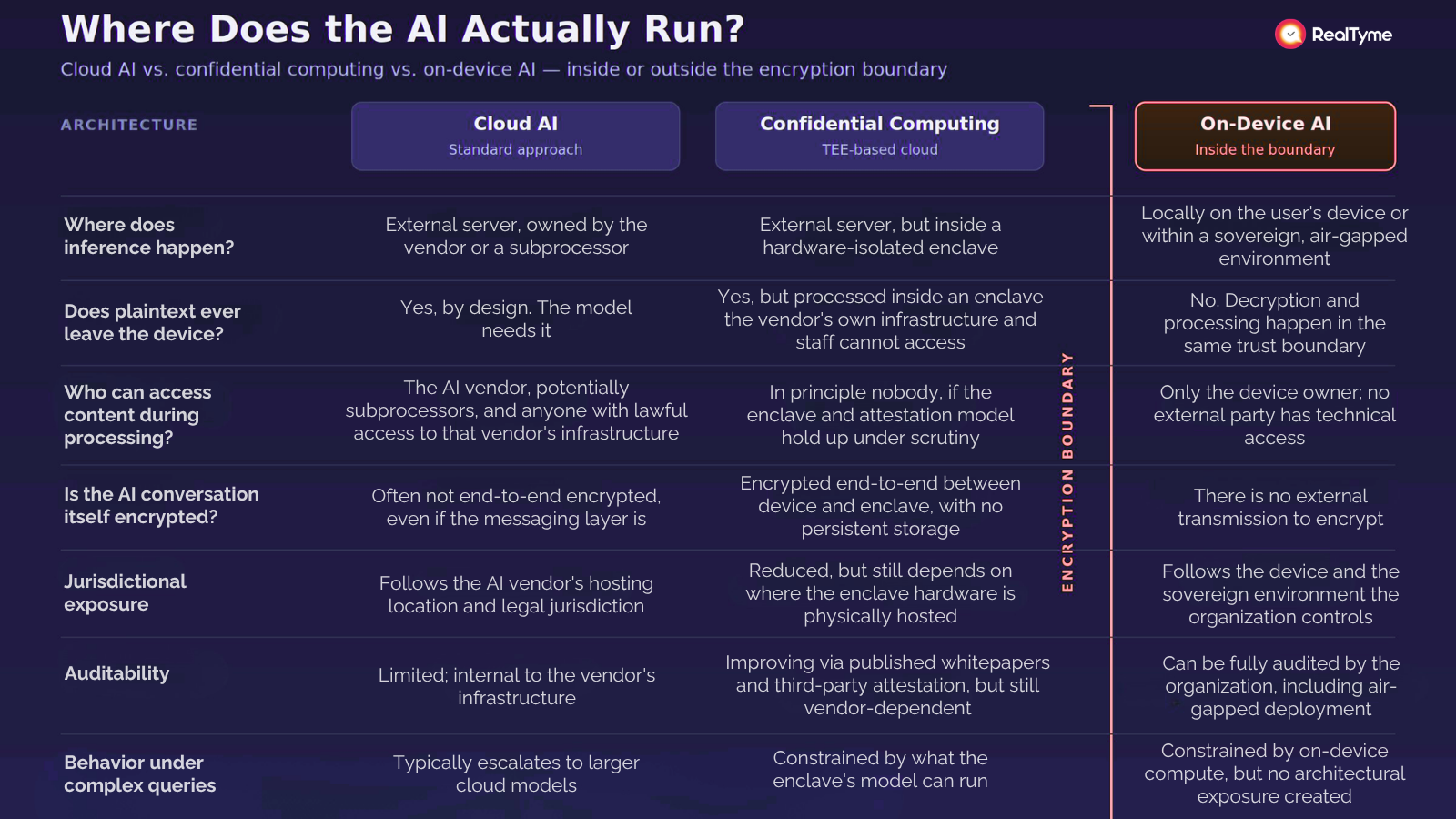
This table is the practical version of the architecture question every security or procurement team should be asking before approving an AI-enabled communications platform.
Note that confidential computing is a genuine improvement over standard cloud AI, but for classified, defense, or highly regulated use cases, it still doesn't match the guarantees of fully on-device processing — it depends on trusting a specific vendor's hardware and implementation rather than removing the trust requirement altogether.
Why This Matters More Than Ever Right Now
Three forces are converging to make this an urgent architectural decision rather than a theoretical one:
AI features are becoming default, not optional
Consumer and enterprise messaging platforms are shipping AI-assisted summarization, search, and drafting as standard functionality. Organizations that haven't explicitly evaluated where that processing happens are likely already exposed without having made an active decision to be.
Regulatory scrutiny of cross-border data flows is intensifying
Frameworks like the EU's data protection regime and various national data sovereignty requirements increasingly treat "processed by a foreign cloud AI provider" as a meaningful jurisdictional exposure, regardless of whether the underlying transport was encrypted.
Harvest-now-decrypt-later threats raise the stakes on any plaintext exposure
Every time a message is decrypted for AI processing, even briefly, it creates a window that didn't exist before. In a threat landscape where adversaries are already harvesting encrypted traffic for future decryption, minimizing every unnecessary decryption event is a security discipline, not a nice-to-have.
What This Looks Like for Regulated and Sovereign Organizations
For governments, defense agencies, and regulated enterprises, the practical guidance is straightforward:
- Treat any cloud-routed AI feature inside a messaging platform as a data exfiltration path, and evaluate it under the same scrutiny as any third-party integration — because that's what it is.
- Ask vendors directly where inference happens, not whether the platform is "secure" or "encrypted." Those words no longer mean what they used to if AI is involved.
- Prioritize platforms built with edge AI as a foundational architecture decision, not a bolt-on feature layered onto a cloud-first product after the fact.
- Require sovereignty guarantees that extend to AI processing, not just data storage and transport. Data residency requirements that don't account for where AI inference happens within a sovereign cloud leave a gap.
What Good Looks Like: A Procurement Checklist
For teams evaluating secure communications platforms with AI features, it helps to turn the architectural principles above into concrete procurement questions.
Before signing off on any platform that combines messaging and AI, ask the vendor to answer (in writing, not in a sales deck) the following:
1. Where physically does the AI model run when it processes a user's message: on the device, in a vendor-controlled cloud, or in a customer-controlled sovereign environment?
2. Is there any scenario in which plaintext, embeddings, or derived content generated from a message is transmitted off the device? If yes, under what conditions, and can it be disabled?
3. Can the AI feature be fully deployed in an air-gapped or on-premises environment for classified or highly sensitive use cases?
4. What subprocessors, if any, have access to content processed by the AI feature, and in which jurisdictions do they operate?
5. Is the AI model itself something the organization can inspect, replace, or run independently of the vendor's cloud infrastructure?
6. What happens to data used to improve or fine-tune the AI model — is any customer content used for training, and can this be contractually excluded?
A vendor that can answer all six clearly and specifically has almost certainly built AI as part of the architecture rather than as a feature bolted on afterward.
A vendor that answers with marketing language about "bank-grade encryption" without addressing where inference happens hasn't actually answered the question.
How RealTyme Approaches This: Edge AI, Not Cloud AI
This is the exact problem RealTyme was built to solve. As a Swiss-based sovereign communications platform serving governments, defense agencies, and regulated enterprises, RealTyme starts from the assumption that any AI feature routed through a third-party cloud is a data exposure an organization didn't sign up for, regardless of how the vendor markets it.
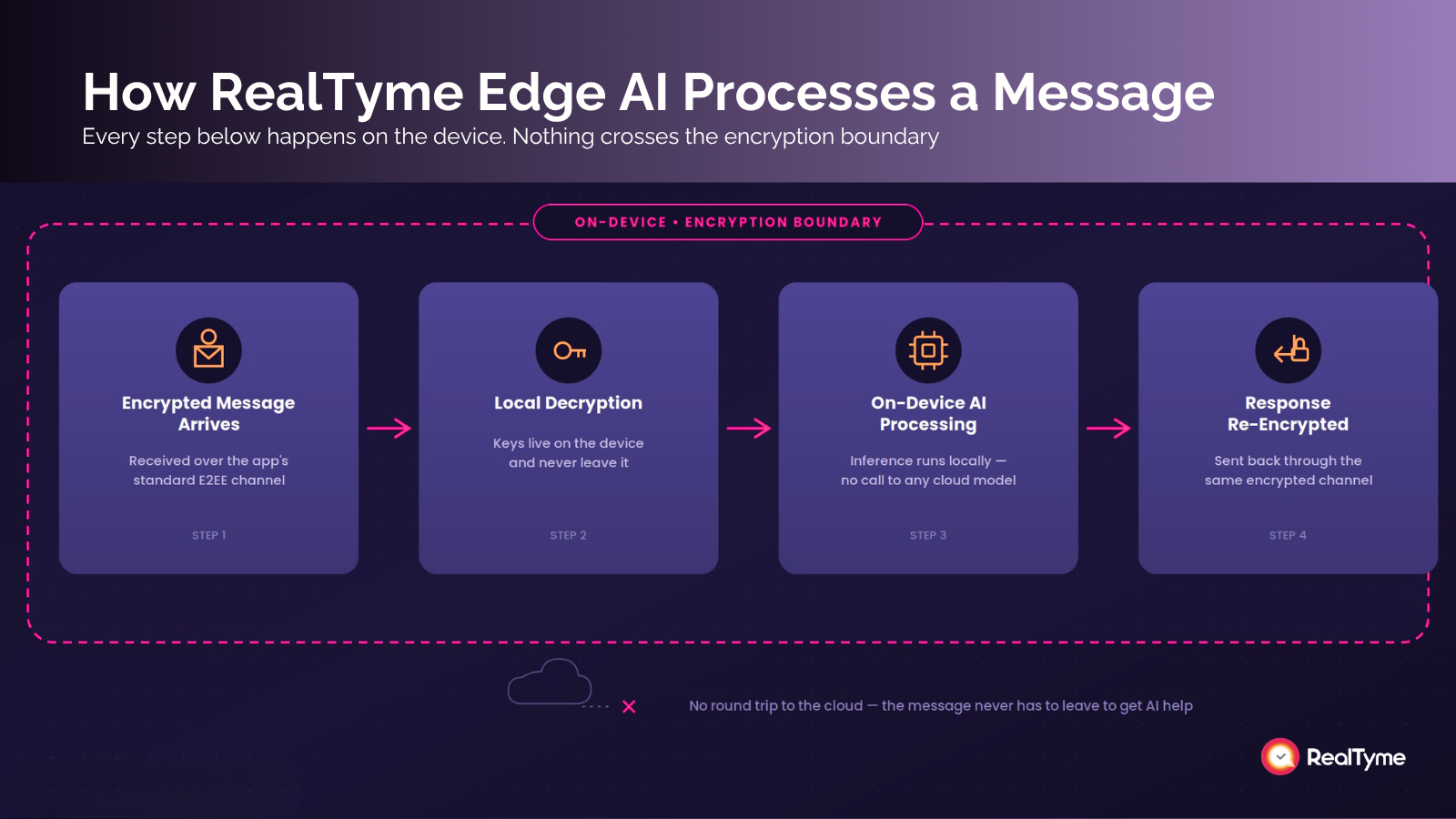
RealTyme's Edge AI approach runs inference on-device or within a customer-controlled sovereign environment, inside the same trust boundary as the platform's end-to-end encryption. There's no hybrid fallback that quietly routes harder queries to an external cloud model, and no confidential-computing enclave whose security depends on trusting a third party's hardware implementation.
The AI capability and the encryption guarantee are the same architectural decision, not two systems stitched together after the fact. This means Edge AI can be deployed in fully air-gapped and classified environments where cloud-dependent AI, however well engineered, simply isn't an option.
For organizations running through the procurement checklist above, that's the difference between a secure messaging platform that can answer all six questions in writing and one that needs a caveat for at least one of them.
The Bottom Line
AI and end-to-end encryption are not inherently incompatible. The incompatibility only exists when AI is built the way most of the industry has built it: cloud-first, with encryption bolted on around it rather than designed with it from the start.
The platforms that will earn trust from governments, defense organizations, and regulated enterprises over the next several years are the ones that solved this at the architecture level — where AI capability and encryption guarantees aren't competing priorities, but the same design decision, made once, correctly.
That's the design principle behind RealTyme's approach to trust and promise in sovereign communications.
Frequently Asked Questions
Can AI assistants work inside end-to-end encrypted apps?
Yes — but only if the AI model runs entirely on-device, inside the same trust boundary as the encryption itself. If any part of processing happens on a cloud server, the message is effectively decrypted outside the recipient's device, which breaks the core guarantee of end-to-end encryption.
Can AI read encrypted messages?
Only if they're decrypted first. Cloud-based AI assistants require plaintext to function, which most mainstream AI features provide by decrypting content before sending it for processing. An on-device AI model can "read" messages locally, after the device has already decrypted them for the user, without transmitting anything externally.
Does adding AI features to a messaging app break end-to-end encryption?
It depends entirely on architecture. Cloud-routed AI weakens the security model, even if the underlying transport encryption stays intact, because plaintext or derived data leaves the encrypted channel.
Confidential-computing approaches — such as Meta's Private Processing behind WhatsApp's Incognito Chat with Meta AI — narrow that exposure by processing data inside hardware-isolated enclaves the vendor itself can't access, but they still depend on cloud infrastructure and vendor implementation.
On-device AI with no external data transmission is the only approach that preserves the end-to-end encryption guarantee without requiring trust in a third party's hardware.
What is edge AI in the context of encrypted communications?
Edge AI means running AI models locally on a device or within a controlled sovereign environment, rather than routing data to a centralized cloud service. In encrypted messaging, it's the architecture that enables AI features without reintroducing the plaintext exposure that cloud-based AI requires.
Why does this matter for governments and regulated industries specifically?
Because they operate under data sovereignty, classification, and compliance requirements that treat any unauthorized data exposure — even momentary, even to a "trusted" AI vendor — as a serious risk. On-device AI inside the encryption boundary is the only architecture that satisfies both the demand for AI capability and the requirement for sovereign, auditable control.
Is on-device AI as capable as cloud-based AI?
For most common tasks — summarization, translation, search, drafting assistance — the gap has narrowed significantly as smaller, efficient models have improved. On-device models are generally smaller than the largest cloud-hosted models, but the relevant comparison for a security-conscious organization isn't raw capability — it's on-device AI versus the risk of routing sensitive communications through a third-party cloud service.
How can a security team verify a vendor's on-device AI claims rather than just trusting the marketing?
Ask for architecture documentation, not brochures. Legitimate on-device AI should be demonstrable through network traffic analysis showing no outbound calls during AI processing, deployment options supporting fully air-gapped environments, and willingness to have the claim independently audited.


.svg)
.svg)

.svg)
.svg)
